
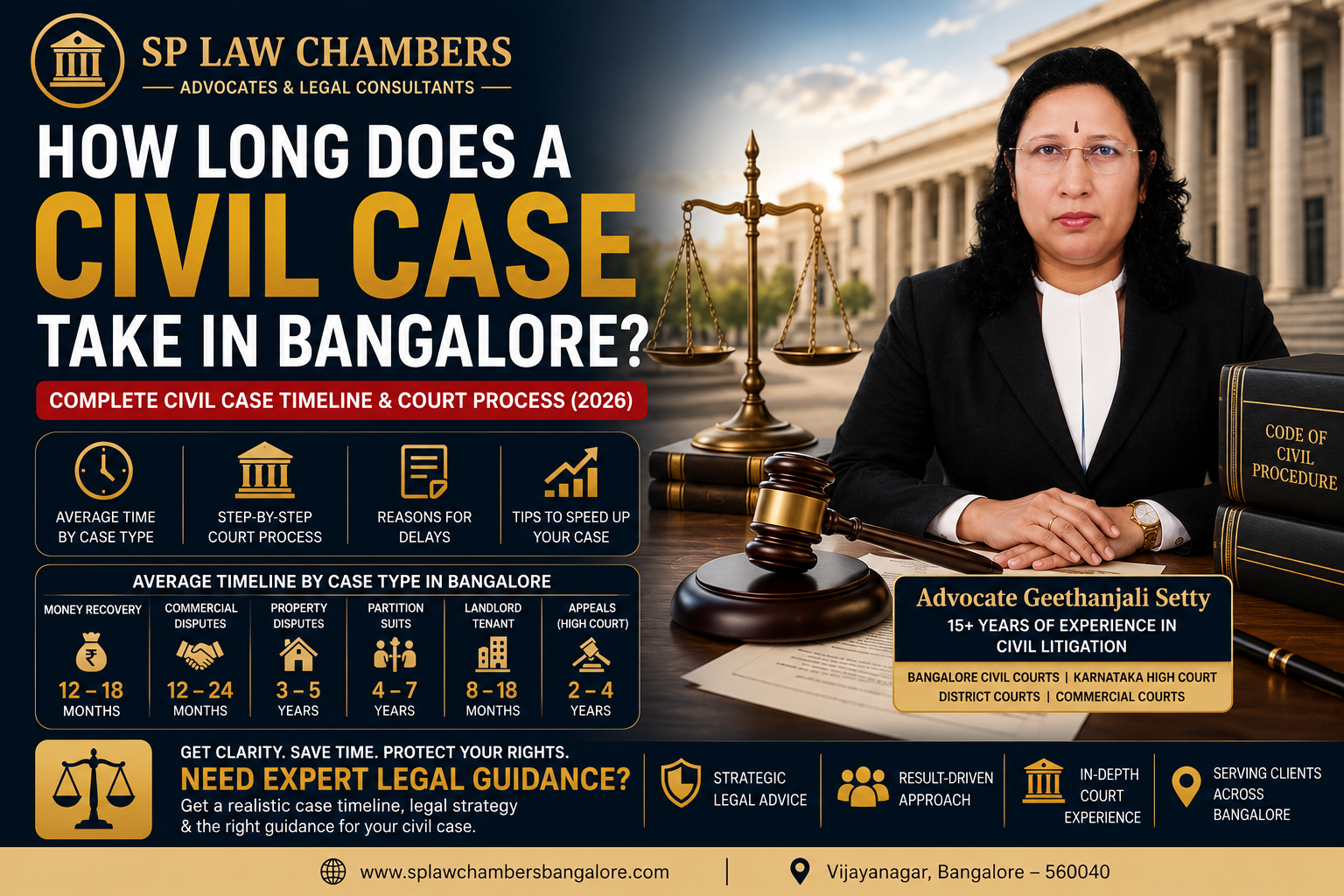
When someone considers filing a lawsuit in Bangalore, their first reaction is usually fear. People expect cases to drag on for decades. Clients frequently walk into our Vijaynagar office asking about the civil case timeline Bangalore courts follow before they even explain their core legal problem. They worry about endless adjournments, mounting legal bills, and wasting years in court corridors.
While judicial backlogs do exist, not every lawsuit takes ten years to resolve. The actual time it takes depends heavily on how your advocate drafts the initial pleadings and enforces procedural rules under the Code of Civil Procedure (CPC). If you are wondering how long does a civil suit take in Bangalore, the answer depends on the exact nature of your claim. Different types of civil cases in Bangalore move through the system at very different speeds.
For example, simple money recovery claims or tenant evictions usually conclude much faster than complex ancestral property disputes or breach of contract claims against builders. Commercial lawsuits also follow their own strict, fast-track rules.
In this guide, we break down the practical civil litigation procedure Bangalore courts operate under in 2026. You will learn realistic, stage-by-stage court durations for matters before the Civil Court Bangalore and the Karnataka High Court. Retaining a dedicated civil case lawyer Bangalore who understands these benches daily is key to reducing delays and protecting your legal timeline.

Written By: Advocate Geethanjali Setty
Experience: 15+ Years in Criminal Defence & Bail Matters
Verified Track Record: 99% winning cases across multi-tier trials
Firm: SP Law Chambers, Vijaynagar, Bangalore
How Long Does a Civil Case Take in Bangalore?
Quick Answer: A standard civil lawsuit in Bangalore usually takes between 12 and 36 months from the date of filing to final judgment. The exact civil case timeline Bangalore litigants experience depends on the type of claim, the volume of evidence, and the current bench workload. If you are asking how long does a civil suit take in Bangalore for routine matters like unpaid invoices or rental evictions, courts often resolve them within 12 to 18 months. On the other hand, the court duration for property dispute Karnataka judges handle, especially complex ancestral partition suits, can extend to 3 to 5 years before the Civil Court Bangalore. Commercial disputes governed by the Commercial Courts Act finish much faster due to strict statutory deadlines.
Table of Contents
-
How Long Does a Civil Case Take in Bangalore?
-
Average Civil Case Timeline by Case Type
-
Civil Court Process Explained Step-by-Step
-
What Factors Delay Civil Cases?
-
Civil Case Timeline under the Commercial Courts Act
-
Civil Court vs Karnataka High Court Timeline
-
How to Reduce Delay in Civil Litigation
-
Real Case Timelines (Examples)
-
How SP Law Chambers Helps Reduce Litigation Delays
-
FAQs
Average Civil Case Timeline by Dispute Type in Bangalore (2026)
Every lawsuit moves at its own pace. The court handling your matter plays a huge role in determining the overall civil case timeline Bangalore residents experience.
In Bangalore, civil litigation is divided across specialized court complexes based on jurisdiction and subject matter. Property and civil suits typically go before the City Civil Court complex near Mysore Bank Circle or the Mayo Hall units. Eviction matters run through the Small Causes Court Bengaluru, while business disputes are directed to the dedicated Commercial Court Bengaluru. If either side appeals, the case moves to the High Court of Karnataka.
Because court procedures vary by dispute type, checking your Civil Court Bangalore case status timeline requires knowing where your claim fits. For example, the execution of property dispute resolution in Bangalore or knowing the average time for money recovery suit in Civil Court Bangalore is relatively brief compared to title disputes. Conversely, if you are asking how long does property partition suit take in Bangalore, you must account for multiple legal stages and multiple family heirs.
Civil Case Duration Comparison
| Civil Case Type | Average Timeline | Court |
| Money Recovery Suit | 12–18 Months | Civil Court |
| Commercial Suit | 12–24 Months | Commercial Court |
| Property Dispute | 3–5 Years | Civil Court |
| Partition Suit | 4–7 Years | Civil Court |
| Landlord-Tenant | 8–18 Months | Small Causes Court |
| Contract Dispute | 18–30 Months | Commercial / Civil Court |
| Appeal | 2–4 Years | Karnataka High Court |
Practical Litigation Insight: These timelines are indicative averages based on the nature of litigation, procedural stages under the Code of Civil Procedure, court workload, and practical litigation experience. Individual cases may vary depending on evidence, interim applications, and compliance by the parties.
What Are the Stages of a Civil Suit Under the Code of Civil Procedure (CPC)?
Understanding the civil suit lifecycle helps take the mystery out of the court process. Every lawsuit filed in Bangalore strictly follows the stages of civil suit CPC timeline laid down by the Code of Civil Procedure, 1908.
Navigating the civil litigation procedure Bangalore trial courts enforce requires clearing several distinct procedural hurdles. Each stage moves the dispute closer to a final judgment. To understand the baseline timeline restrictions before a case can even be filed, make sure to consult the rules governing the limitation period for civil cases in India.
-
Filing of the Plaint: Litigation starts when the plaintiff files a formal written complaint called a plaint. This document outlines the facts, names the defendants, specifies the cause of action, and states the exact relief sought from the court. To understand this initial filing step thoroughly, review our separate manual on how to file civil suit in Bangalore.
-
Issue of Summons: Once the court registry scrutinizes and registers the plaint, the judge issues a formal court summons. This notice directs the defendant to appear in court on a scheduled date to answer the legal claims.
-
Written Statement (Order VIII Rule 1 CPC): The defendant must file their defense, known as a written statement. Under strict CPC rules, this must be filed within 30 days of receiving the summons, with an absolute maximum outer limit of 90 days.
-
Framing of Issues: After reading the plaint and written statement, the judge identifies the exact core disagreements between both sides. The court frames specific factual and legal questions that must be decided during the trial phase.
-
Recording of Evidence & Cross-Examination: This is typically the longest stage of litigation. Both sides submit written affidavits of evidence and produce original documents. Opposing advocates then cross-examine the witnesses in open court to test their honesty and accuracy.
-
Final Arguments: Once all oral and documentary evidence is recorded, the advocates present their concluding arguments. They summarize the trial record and cite relevant High Court and Supreme Court judgments to support their side.
-
Judgment & Decree: After hearing both sides, the judge reserves the matter and pronounces the final verdict. The court issues a formal judgment explaining its reasoning, followed by a decree stating the exact legal relief granted.
-
Execution Proceedings: If the losing party refuses to obey the judgment, the winner files an execution petition. The court then takes coercive steps, like attaching bank accounts or seizing property, to enforce the decree.
Why Do Civil Cases Get Delayed in Bangalore? Common Reasons You Should Know
When assessing the overall civil case timeline Bangalore litigants face, it is important to realize that not every delay is caused by judicial backlogs. Many bottlenecks arise directly from procedural friction, complex evidence collection, uncooperative parties, or multiple layers of appeals. Understanding these common roadblocks allows you to work proactively with your legal counsel to keep your lawsuit moving forward.
Frequent Adjournments by Parties
One of the most common reasons a lawsuit stalls is requests for time by advocates or litigants. Whether parties ask for extensions to file written statements, prepare affidavits, or accommodate personal emergencies, repeated adjournments significantly extend the case lifecycle.
Delay in Serving Summons
A lawsuit cannot progress until the defendant is officially notified. If the opposing party evades court notices, provides an outdated address, or if postal delivery fails, issuing fresh summons through newspaper publications can delay the trial by several months.
Lengthy Evidence & Cross-Examination
In heavy disputes involving numerous witnesses and boxes of documentary evidence, the recording of testimony takes immense time. Detailed cross-examination duration by opposing advocates often requires multiple dedicated court sessions over many months.
Interim Applications & Injunction Proceedings
During a pending suit, parties frequently file urgent interlocutory applications under Order XXXIX Rules 1 & 2 CPC for temporary injunctions. Arguing and deciding these mini-battles temporarily pauses progress on the main trial. If your case centers heavily on property access or structural construction blocks, read our overview on temporary vs permanent injunctions in Bangalore to understand how these interim applications affect your core timeline.
Appeals Before the Karnataka High Court
If a trial court passes an adverse interim order during the suit, the aggrieved party often challenges it before the High Court. Such revision petitions or interim appeals frequently halt proceedings in the lower court until the appellate bench decides the matter.
Common Reasons Civil Cases Take Longer
-
Multiple defendants with conflicting interests
-
Property valuation and survey disputes
-
Missing or uncertified original documents
-
Numerous witnesses requiring extensive questioning
-
Highly contested interim injunction applications
-
Frequent adjournments requested by legal counsel
-
Interlocutory appeals filed before higher benches
Why do civil cases take so long in Bangalore?
Civil cases may take longer due to procedural requirements under the Code of Civil Procedure, repeated adjournments, complex evidence, multiple parties, interim applications, and appeals before higher courts. Proper case preparation and timely compliance can significantly reduce unnecessary delays.
Civil Court vs Karnataka High Court Timeline – Which Takes Longer?
Understanding judicial hierarchy is critical when tracking your Civil Court Bangalore case status timeline. The legal duration of your dispute depends heavily on whether your matter is being heard before a trial court or an appellate bench.
The Bengaluru City Civil Court complex primarily functions as a court of original jurisdiction. This means it handles the initial filing, frames factual issues, inspects physical evidence, and records live witness testimony. Because recording evidence is a meticulous, step-by-step procedure, original lawsuits take substantial time to reach a final verdict.
In contrast, the High Court of Karnataka, Bengaluru, primarily exercises appellate, revisional, and writ jurisdiction. When a civil matter reaches the High Court via a regular first appeal, second appeal, or civil revision petition, the bench generally does not record fresh witness testimony. Instead, senior judges evaluate the legal correctness of the lower court’s judgment based on existing trial records. However, due to heavy constitutional and appellate caseloads, the Karnataka High Court timeline for listing and finally arguing regular civil appeals can still span multiple years. If you are preparing to mount a challenge against a lower court decree, view the tactical process for appealing civil judgment high court Bangalore.
Specialized Appellate Overviews
For complex matters transitioning to superior benches, our appellate practice at SP Law Chambers is driven by Advocate Sushmita Shankar. Holding a B.A., L.L.B. degree with a verified 99% winning record in high-tier litigation (credentials verified in image_b49be2.jpg), she specializes exclusively in Civil Law appellate frameworks. Her day-to-day practice involves arguing appeals, civil revisions, and high-stakes contractual or property arbitrations.
Furthermore, when lower court procedures hit unconstitutional delays, she routinely files constitutional writs under Article 226 before the Karnataka High Court, Bengaluru and Article 32 before the Supreme Court of India to secure and enforce the fundamental legal rights of our clients.
| Particular | Civil Court | Karnataka High Court |
| Original Suit | Yes | Rare |
| Appeal | No | Yes |
| Average Timeline | 1 to 3 Years | 2 to 4 Years |
| Evidence Stage | Yes | Usually No |
| Fresh Trial | Yes | No |
Civil Case Timeline Under the Commercial Courts Act, 2015
For businesses facing B2B disputes, vendor conflicts, or breach of contract claims, the standard civil litigation complete guide for Bangalore residents can feel slow. Fortunately, lawsuits involving commercial disputes valued over a specified statutory threshold are governed by the Commercial Courts Act, 2015.
The Commercial Courts Act resolution time Bangalore judges aim for is significantly faster than standard civil litigation. The Commercial Court Bengaluru operates under strict statutory case management rules. Parties must complete mandatory pre-institution mediation before filing, disclose all relevant documents upfront, and adhere to rigid timelines that severely penalize unnecessary adjournment requests.
| Feature | Normal Civil Suit | Commercial Court |
| Timeline | Flexible timeline | Strict statutory timeline |
| Adjournments | Frequent adjournments | Controlled hearings |
| Duration | Longer duration | Faster disposal |
Businesses involved in contractual disputes, shareholder disagreements, recovery claims, or commercial transactions may benefit from proceedings under the Commercial Courts Act where applicable. Whether a matter qualifies depends on statutory requirements and the nature of the dispute.
How Can You Reduce the Time Taken for a Civil Case in Bangalore?
While litigants cannot control judicial schedules, a disciplined litigation strategy can shave months or even years off your case lifecycle. If you are exploring how to speed up a civil case in High Court of Karnataka or lower civil courts, implementing proactive legal measures is essential.
Choose the Correct Court
Filing your claim before the wrong jurisdictional bench guarantees immediate delays. Your advocate must precisely determine territorial, pecuniary, and subject-matter jurisdiction, such as routing commercial claims directly to the dedicated Commercial Court, before filing.
Prepare Complete Documentation Before Filing
Never file a half-prepared plaint hoping to gather documents later. Organize all certified deeds, bank statements, legal notices, and witness lists upfront so your evidence affidavits can be filed without seeking court extensions.
Avoid Unnecessary Adjournments
Work closely with your counsel to ensure someone is always present and prepared to argue on scheduled hearing dates. Agreeing to unnecessary adjournments requested by the opposing side directly hurts your timeline.
Explore Court-Annexed Mediation & ADR
Utilizing Alternative Dispute Resolution (ADR) tools, such as court-annexed mediation centres or Lok Adalat sittings, offers a fast, binding, and mutually agreeable exit from litigation without waiting for a lengthy trial verdict.
Work with an Experienced Civil Litigation Lawyer
An experienced trial team understands local court nuances. At SP Law Chambers, we draft tight pleadings, enforce strict compliance with CPC timelines, and aggressively resist procedural delay tactics attempted by opposing parties.
How to Reduce Civil Litigation Delays
-
File complete, well-drafted pleadings on day one
-
Respond to court notices within strict CPC statutory limits
-
Maintain organized, certified documentary evidence
-
Attend scheduled hearings regularly without default
-
Consider court-annexed mediation for early settlement
-
Avoid filing frivolous interlocutory applications
-
Seek timely legal advice before procedural errors occur
While no lawyer can guarantee how quickly a court decides a case, proper legal strategy, complete documentation, timely filings, and exploring settlement options can significantly reduce avoidable delays in civil litigation.
Real Civil Case Timeline Examples in Bangalore
To give you a realistic perspective on court expectations, here are typical case duration brackets observed across Bangalore courts:
Money Recovery Suit
-
Dispute: A vendor suing a corporate client for unpaid supply invoices with clear documentary proof. If your case is a financial default issue, it is recommended to read our specific breakdown on how to recover money legally in Bangalore.
-
Estimated Timeline: 14 Months
Commercial Contract Dispute
-
Dispute: A B2B software delivery breach filed before the dedicated Commercial Court Bengaluru.
-
Estimated Timeline: 18 Months
Property Partition Suit
-
Dispute: A contested family partition involving multiple properties, three generations of heirs, and valuation challenges.
-
Estimated Timeline: 4 Years
Permanent Injunction Suit
-
Dispute: A homeowner seeking to permanently restrain a neighbor from illegal encroachment and construction.
-
Estimated Timeline: 18 to 24 Months
Disclaimer: These examples are illustrative only. Actual timelines depend on the facts of each case, court workload, procedural compliance, and judicial discretion.
How SP Law Chambers Helps Clients Navigate Civil Litigation Efficiently
At SP Law Chambers, our civil litigation practice is built on precision, thorough preparation, and procedural discipline. We do not believe in allowing lawsuits to sit idle on the court diary. Instead, our team actively utilizes the strict provisions of the Code of Civil Procedure to compress timelines and force prompt hearings.
Our trial and appellate strategies are executed by seasoned legal professionals:
-
Advocate Geethanjali Setty (B.B.A., L.L.B.): Manages comprehensive civil trials, debt recoveries, and complex family court disputes with over 8+ years of rooted litigation experience across the District Courts, High Court, and the Supreme Court.
-
Advocate Sushmita Shankar (B.A., L.L.B.): Directly commands our superior court appellate practice, managing intricate civil revisions, property arbitrations, and constitutional writ petitions.
By maintaining a verified 99% winning case benchmark across our documented firm portfolios, we focus on moving your case forward efficiently. We begin every engagement with a strategic case assessment to identify potential procedural bottlenecks before they happen. Our legal team drafts meticulous, watertight pleadings and conducts exhaustive document reviews to ensure your evidentiary record is bulletproof from the outset.
When urgent relief is necessary, we aggressively press for interlocutory injunctions to protect your rights. Throughout the trial, we actively manage court appearances, resist frivolous adjournment requests, and provide practical legal counsel on settlement negotiations and appeals to help you achieve a decisive resolution.
 Call Us: +91-9916957929 Available for urgent legal emergencies
 Email: splawchambersbangalore@gmail.com
 Visit Our Office: No 101, Ashwathnarayana Nilaya, Railway Parallel Rd, Hampi Nagar, RPC Layout, Vijaya Nagar II Stage, Bengaluru, Karnataka 560104
 Google Maps: Check Our Google My Business Listing for Reviews
Frequently Asked Questions About Civil Case Timelines in Bangalore
Can a civil case finish within six months in Bangalore?
Yes, but only under specific circumstances. Simple disputes involving clear documentary evidence, matters resolved through court-annexed mediation, or fast-track commercial suits where the defendant concedes liability can conclude within six months.
How long does a property dispute take in Bangalore?
A standard property title or partition suit before the City Civil Court generally takes between 3 to 5 years. The court duration for property dispute Karnataka judges oversee depends heavily on the number of legal heirs, property surveys, and injunction challenges.
Why are civil cases delayed?
Civil cases face delays due to strict procedural mandates under the Code of Civil Procedure, difficulties in serving court summons to evasive defendants, requests for adjournments by counsel, lengthy witness cross-examinations, and interim appeals.
Does mediation reduce court time?
Absolutely. Opting for Alternative Dispute Resolution or court-annexed mediation pauses the formal trial grind. If both parties reach a mutually agreeable settlement through a mediator, the court converts the agreement into a binding compromise decree.
Can the Karnataka High Court speed up my case?
In instances of severe, unreasonable, and prolonged delays by a lower court, litigants can file a writ petition under Article 227 of the Constitution requesting the Karnataka High Court to issue expedited disposal directions to the trial court.
Key Takeaways – Civil Case Timeline in Bangalore
-
Standard civil lawsuits in Bangalore generally take between 1 to 3 years from filing to final decree.
-
Complex ancestral property and partition disputes often take longer due to multiple parties and detailed evidentiary requirements.
-
Lawsuits filed under the Commercial Courts Act usually resolve faster thanks to strict statutory case management hearings.
-
Preparing comprehensive, organized documentation before filing significantly reduces procedural delays during the trial phase.
-
Exploring court-annexed mediation or out-of-court settlements can successfully shorten litigation by years.
-
Filing interlocutory appeals before higher benches naturally pauses lower court proceedings and extends timelines.
-
Seeking early legal advice from an experienced trial team helps avoid costly procedural mistakes that drag cases out.
Concerned About How Long Your Civil Case May Take?
Every civil dispute follows its own timeline based on the facts, applicable law, court procedures, and the approach adopted during litigation. If you want a realistic assessment of your case, guidance on procedural timelines, or advice on reducing unnecessary delays, consulting an experienced civil litigation lawyer can help you make informed decisions.
SP Law Chambers assists individuals and businesses across Bangalore with civil litigation strategy, property disputes, commercial disputes, recovery suits, injunction matters, and appeals before the Karnataka High Court.

Advocate Geethanjali Setty is the driving force behind SP LAW CHAMBERS. With over 14 years of hands-on legal experience, she is known for her ethical, result-oriented approach. Geethanjali is registered with the Bar Council of Karnataka and has built a reputable practice offering comprehensive legal consultancy and advisory services. She and her team of six dedicated advocates handle a wide range of legal matters with integrity and efficiency.
At SP LAW CHAMBERS, clients receive not just legal expertise, but also a commitment to clear, client-focused guidance. Geethanjali’s focus on client satisfaction and her proven track record make her a trusted name in the Bangalore legal community.