

Have you recently received an income tax or GST notice? Are you disagreeing with an assessment, facing penalty proceedings, or unsure how to challenge a sudden tax demand? Tax problems can quickly escalate from standard compliance issues into complex legal disputes. For individuals, entrepreneurs, CFOs, and finance teams in Bangalore, navigating these waters requires more than just accounting knowledge—it requires an understanding of your legal rights and remedies.
Tax litigation is not limited to arguing in a courtroom. The process often begins the moment you receive a notice and moves through departmental replies, assessments, appeals, and tribunals. If you are looking for a Tax Litigation Lawyer in Bangalore, SP Law Chambers, located in Vijaynagar, is dedicated to helping clients decipher their tax disputes and build a strategic legal response. This guide breaks down exactly how tax litigation works, what your options are, and when it is time to seek legal representation.
What is tax litigation in Bangalore?
Tax litigation in Bangalore refers to legal proceedings arising from disputes between a taxpayer and tax authorities, including notice responses, assessments, appeals, tribunal proceedings, and, where legally appropriate, proceedings before the Karnataka High Court.
Facing an immediate tax issue? Call SP Law Chambers today to discuss your tax dispute and explore your legal options.
Table of Contents
-
1-Minute Summary: What You Need to Know
-
What Is Tax Litigation and When Does a Tax Dispute Become a Legal Case?
-
What Types of Tax Disputes Does a Tax Litigation Lawyer Handle?
-
Income Tax Litigation in Bangalore: From Notice to Appeal
-
GST Litigation in Bangalore: Notices, Demand Orders & Appeals
-
How Does the Tax Litigation Process Work in India?
-
Where Can Tax Disputes Be Appealed in India?
-
When Should You Hire a Tax Litigation Lawyer in Bangalore?
-
What Does a Tax Litigation Lawyer Actually Do?
-
Tax Litigation for Individuals, Businesses & Companies in Bangalore
-
What Documents Should You Keep Ready for a Tax Dispute?
-
What Happens If You Ignore a Tax Notice or Appeal Deadline?
-
Tax Litigation in Bangalore: Why Local Legal Knowledge Matters
-
Why Choose SP Law Chambers for Tax Litigation in Bangalore?
-
Tax Litigation FAQs — Bangalore
-
Final Takeaway
⏳ In 60 Seconds: What You Need to Know About Tax Litigation
A tax dispute typically starts with a formal notice, assessment, or demand.
The most critical first step is understanding the exact nature of the order and your strict legal deadline.
Many matters can be resolved at the departmental stage with a strong legal reply.
Adverse orders create statutory appeal rights for taxpayers.
Depending on the issue, your case may proceed to the CIT(A)/JCIT(A), ITAT, GST appellate forums, or the Karnataka High Court.
The correct forum and timeline depend entirely on the specific tax law and the type of proceeding.
Need help understanding a tax notice or order?
Call SP Law Chambers to discuss the nature of your tax dispute and the available legal route.
What Is Tax Litigation and When Does a Tax Dispute Become a Legal Case?
There is a distinct difference between tax compliance, tax assessment, and tax litigation. Compliance involves filing returns and paying taxes on time. Assessment is the department’s review of those filings. A tax dispute arises when the taxpayer and the tax authority disagree on the assessment, the interpretation of the law, or the calculation of liability.
Not every tax notice is automatically a court case. In fact, most disputes begin at the desk of an Assessing Officer. Litigation officially kicks in when a formal legal challenge is mounted against an action or order by the tax department.
The typical progression looks like this:
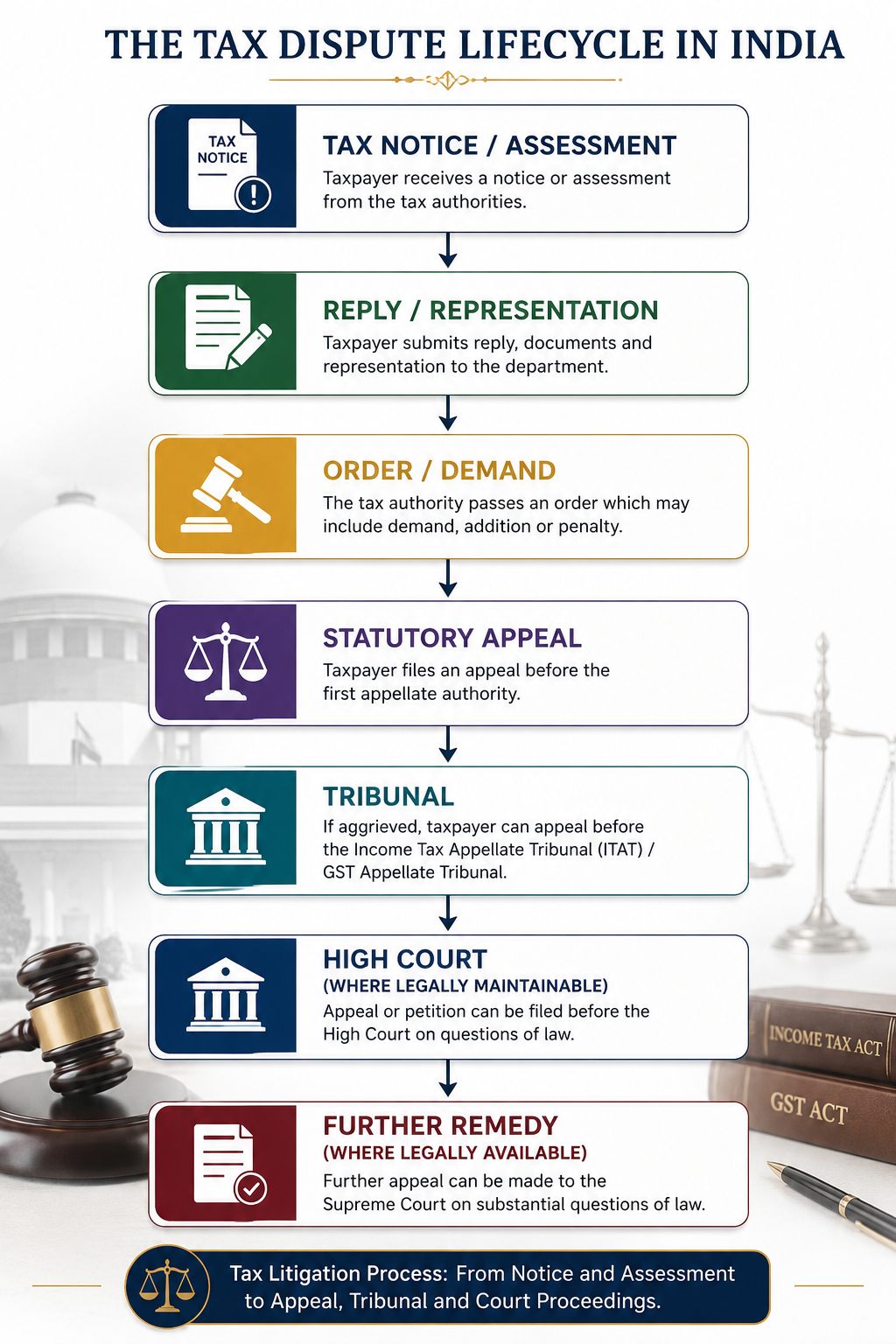
Notice → Reply/Representation → Assessment/Adjudication → Statutory Appeal → Tribunal → High Court (where legally maintainable).
Understanding this lifecycle is crucial because your legal strategy must adapt to the specific stage of your dispute.
Common Situations That Lead to Tax Litigation
A case usually enters the realm of tax disputes, appeals, and litigation due to high-value or complex issues, such as:
-
Disputed tax demands and unexpected liabilities.
-
Intense income-tax assessments or scrutiny.
-
Reassessment proceedings for alleged escaped income.
-
Harsh penalty proceedings.
-
GST demand or adjudication orders.
-
Input Tax Credit (ITC) denial or disputes.
-
Classification disputes (e.g., incorrect GST rates applied).
-
TDS/TCS deduction or default disputes.
-
Refund-related rejections.
-
Transfer-pricing disputes for eligible corporate entities.
What Types of Tax Disputes Does a Tax Litigation Lawyer Handle?
A dedicated tax dispute lawyer in Bangalore manages a wide variety of conflicts across different tax regimes. Here is a breakdown of the typical disputes and where they are contested:
| Dispute Category | Typical Issue | Possible Litigation Stage |
| Income Tax | Disputed assessment, addition, or demand | Assessing Officer (AO) → Appeal → ITAT |
| GST | Tax demand, ITC denial, classification, penalty | GST Authority → Appeal → GST Tribunal |
| TDS / TCS | Deduction mismatch or default disputes | Department → Statutory Appeal |
| Penalty | Tax-related penalties or prosecution notices | Department → Statutory Appeal |
| Reassessment | Reopening of past files for escaped income | Notice → Assessment → Appeal |
| Transfer Pricing | Adjustments and international taxation disputes | TPO/DRP → Statutory Appeal |
| Refunds | Rejection or unwarranted adjustment of refunds | Department → Statutory Appeal |
Income Tax Litigation in Bangalore: From Notice to Appeal
Income tax dispute resolution is often complex because the stakes are highly personal for individuals and financially critical for businesses. The journey from an initial inquiry to a formal appeal requires precision.
Income Tax Notices and Scrutiny
Taxpayers may receive various types of intimations, inquiry notices, or show-cause notices. The actual notice type and the applicable legal framework dictate the exact response required. A generic reply to a specific statutory notice can severely damage your case. It is vital to decode exactly what the department is questioning before submitting data.
Assessment and Reassessment Disputes
During an assessment, the taxpayer must provide a detailed response supported by relevant documents and legal evidence. If the Assessing Officer issues an adverse assessment order—resulting in disputed additions to your income or a heavy tax demand—you have a formal dispute. Reassessment proceedings (where past years are reopened) carry strict procedural requirements that tax authorities must follow; challenging these procedural lapses is a key part of tax litigation.
Challenging an Adverse Income Tax Order
If an assessment order goes against you, the general progression to challenge it is:
Assessment → First Appeal (CIT(A) / JCIT(A)) → Income Tax Appellate Tribunal (ITAT) → High Court
The High Court will generally only admit appeals that involve a “substantial question of law.” Proper representation at the lower assessment and appellate stages is vital to build the factual foundation of your case.
GST Litigation in Bangalore: Notices, Demand Orders & Appeals
With the rapid evolution of indirect tax laws, GST and income tax litigation in Bangalore form the core of modern tax disputes. GST disputes heavily impact cash flow and daily business operations.
Common GST disputes include:
-
Show-cause notices for alleged short-payment of tax.
-
Formal tax demand orders.
-
Denial of Input Tax Credit (ITC) due to vendor mismatches or portal issues.
-
Disputes over the classification of goods/services (HSN/SAC codes).
-
Interest and penalty levies.
-
Registration cancellations or suspension issues.
-
Issues arising from audits or department inspections.
-
Detention or seizure of goods in transit (where applicable).
GST Dispute Process
The standard route for a GST dispute is:
Notice → Detailed Legal Reply → Adjudication Order → First Appeal → GST Appellate Tribunal (or appropriate further remedy).
It is important to note that not every GST matter automatically follows the exact same route. Some urgent issues, like arbitrary bank attachments or severe procedural violations, might necessitate different legal remedies.
How Does the Tax Litigation Process Work in India?
Navigating the tax litigation process in Bangalore involves a structured sequence of actions. Here is how a tax dispute generally unfolds:
Step 1 — Identify the Notice, Order or Dispute
Read the document carefully. Identify the issuing authority, the exact statutory provision cited, and the financial year in question.
Step 2 — Check the Response or Appeal Deadline
Every legal notice or order has a strict time limit for a response or appeal. Missing this window can result in automatic penalties or the loss of your right to appeal entirely.
Step 3 — Review Records and Evidence
Gather all relevant financial statements, returns, invoices, and previous correspondences. Your legal defense is only as strong as the evidence supporting it.
Step 4 — Prepare the Reply, Objection or Appeal
This involves drafting a legally sound response that addresses the department’s allegations fact by fact, supported by relevant case law and statutory rules.
Step 5 — Representation Before the Relevant Authority
A lawyer or authorized representative presents your case, arguments, and evidence in person or virtually to the adjudicating authority.
Step 6 — Challenge an Adverse Order Where an Appeal Is Available
If the authority passes an unfavorable order, you evaluate the grounds to file a statutory appeal before the designated first appellate authority.
Step 7 — Tribunal or High Court Proceedings Where Applicable
If the first appeal fails, the matter can be escalated to a specialized tribunal (like the ITAT) and, subsequently, to the High Court if a question of law is involved.
Where Can Tax Disputes Be Appealed in India?
The appropriate forum for your appeal depends heavily on the type of tax, the nature of the order, the applicable legislation, and the current stage of your proceeding.
Key appellate forums include:
-
Assessing Officer / Tax Authority: For rectification of apparent mistakes.
-
CIT(A) / JCIT(A): The first appellate authority for income tax disputes.
-
Income Tax Appellate Tribunal (ITAT): The second appellate stage and the final fact-finding authority for direct taxes.
-
GST Appellate Authorities: For first appeals regarding GST orders.
-
GST Appellate Tribunal: (Where applicable and operational) for advanced GST disputes.
-
Karnataka High Court: For appeals involving substantial questions of law.
-
Supreme Court of India: The final apex court for disputes.
Important Note: You cannot bypass the system. A taxpayer cannot simply take a routine factual dispute directly to the High Court; you must follow the statutory appeal mechanism.
When Should You Hire a Tax Litigation Lawyer in Bangalore?
Not every minor intimation requires a lawyer, but certain triggers mean you need professional legal representation immediately. You should consult a Tax Litigation Lawyer in Bangalore if:
You Have Received a Tax Notice
Especially a show-cause notice or a notice for scrutiny assessment that requires a complex legal interpretation.
A Tax Demand Has Been Raised
If you receive a demand for additional taxes that you believe is legally incorrect or miscalculated.
You Disagree With an Assessment or Order
When the Assessing Officer has made additions to your income or denied valid credits, and you intend to challenge it.
A Penalty or Prosecution Risk Has Arisen
Penalty proceedings or notices threatening prosecution carry severe financial and reputational risks.
You Need to File an Appeal
Drafting an appeal requires formatting specific “Grounds of Appeal” and framing legal arguments, which is a lawyer’s domain.
Your Matter Has Reached a Tribunal or Court
Appearing before the ITAT or the High Court requires formal legal drafting, an understanding of court procedures, and experienced advocacy.
The Dispute Involves Significant Financial Exposure
High-value cases, complex corporate structures, or severe business disruptions warrant expert legal oversight.
Received a tax notice or adverse order?
Don’t wait until the response or appeal deadline is close. Call SP Law Chambers for an initial discussion about your matter.
What Does a Tax Litigation Lawyer Actually Do?
A tax appeal lawyer in Bangalore does much more than just forward your documents to the government. We handle the structural legal work of your defense. Our actual work involves:
-
Reviewing the notice/order: Identifying procedural flaws or jurisdictional errors made by the department.
-
Identifying disputed issues: Separating matters of fact from matters of law.
-
Examining documents: Ensuring your evidence directly supports your legal claims.
-
Researching law and precedents: Finding past tribunal or High Court judgments that favor your position.
-
Preparing the legal response: Drafting robust replies, objections, and comprehensive appeals.
-
Representing the client: Arguing your case before the relevant adjudicating authorities or appellate forums.
-
Advising on further remedies: Strategizing the next steps if an authority passes an adverse order.
Tax Litigation for Individuals, Businesses & Companies in Bangalore
Tax disputes affect different entities in uniquely disruptive ways. A skilled Tax Litigation Lawyer in Bangalore tailors the defense to the client’s specific operational reality.
Individuals & Professionals
We handle income-tax notices, disputes over claimed deductions, capital gains controversies, scrutiny assessments, and delayed refund issues for salaried individuals and independent professionals.
Startups & SMEs
Small and medium enterprises often face devastating cash flow issues due to GST disputes, blocked Input Tax Credits, abrupt assessments, or sudden tax demands. We focus on unblocking business operations swiftly.
Companies & Finance Teams
We assist corporate entities with complex assessments, TDS/TCS default notices, high-value GST demands, and navigating tribunal proceedings alongside your internal finance department.
What Documents Should You Keep Ready for a Tax Dispute?
Having a well-organized file is half the battle won. Keep this checklist ready:
-
The exact notice or order received.
-
Relevant tax returns and computations.
-
Any previous submissions or replies made to the department.
-
Tax payment challans.
-
Audited financial statements and bank records (where relevant).
-
Invoices, GST returns, and vendor agreements.
-
Earlier departmental correspondence regarding the same issue.
The Unique Angle: Do not send documents randomly. The biggest mistake taxpayers make is submitting a massive data dump. First, identify exactly what issue the authority has raised, and then provide only the specific documents that directly address that issue.
What Happens If You Ignore a Tax Notice or Appeal Deadline?
Ignoring a notice will not make it go away; it only worsens the situation. The risks include:
-
The department passing an ex-parte adverse order (deciding the case against you without your input).
-
Loss of the opportunity to submit vital evidence on record.
-
Additional interest and heavy penalty exposure.
-
Severe difficulty in challenging the department’s factual findings at a later appellate stage.
-
Strict limitation issues (missing a statutory deadline can permanently destroy your right to appeal).
Never rely on generic deadline advice found online. Deadlines depend entirely on the particular notice/order and the applicable law. Always verify the exact date on your specific document.
The Tax Dispute Lifecycle in India
Tax Litigation in Bangalore: Why Local Legal Knowledge Matters
When choosing legal counsel, local familiarity is a distinct advantage. Effective tax litigation in Bangalore requires an understanding of the regional legal ecosystem. It involves knowing the procedural nuances of local tax offices, appellate bodies, and the Karnataka High Court.
A local lawyer understands exactly whether a specific matter belongs before an assessing authority, a tribunal, or requires a writ petition in the High Court. Furthermore, local representation allows for seamless, in-person coordination with your existing Bangalore-based CA or accounting teams, ensuring your financial data perfectly aligns with your legal strategy.
Why Choose SP Law Chambers for Tax Litigation in Bangalore?
At SP Law Chambers in Vijaynagar, we don’t just process paperwork; we build a strategic legal defense. If you need a Tax Litigation Lawyer in Bangalore, here is how our practice is structured to protect your interests:
Legal Representation Focus
We focus strictly on the legal mechanics of notices, disputes, appeals, and tribunal proceedings, ensuring your rights are protected at every stage.
Case-Specific Strategy
There is no “copy-paste” solution in tax law. Our response depends entirely on the unique facts of your notice, your supporting documents, and the current applicable law.
Bangalore & Karnataka Focus
We are deeply embedded in the local legal ecosystem, handling representation before relevant authorities up to the Karnataka High Court where genuinely applicable.
Clear Communication
Legal jargon shouldn’t obscure your understanding of your own case. We ensure you clearly understand: What happened → What deadline applies → What options exist → What the next step is.
Coordination With Financial Professionals
Tax disputes blur the line between law and accounting. We actively work alongside your CAs and finance professionals to ensure legal arguments are backed by flawless financial records.
Facing a tax dispute, notice or appeal in Bangalore?
Speak with SP Law Chambers about your situation and understand the legal route available to you.
Tax Litigation FAQs — Bangalore
What is tax litigation in Bangalore?
Tax litigation refers to the formal legal proceedings that arise when a taxpayer and the tax department disagree. It covers responses to legal notices, adjudication, statutory appeals, tribunal hearings, and High Court writ petitions.
How do I respond to a tax notice in India?
To respond correctly, you must first identify the specific statutory section cited in the notice, verify your strict deadline, gather relevant supporting evidence, and draft a legal reply addressing the department’s specific queries without providing unsolicited information.
When should I hire a tax litigation lawyer?
You should hire a lawyer immediately if you receive a show-cause notice, face a high-value tax demand, are subjected to penalty proceedings, need to draft formal grounds of appeal, or your case escalates to a tribunal or court.
Where can tax disputes be appealed in India?
Disputes are appealed through a statutory hierarchy. Depending on the law, appeals move from the Assessing Officer to first appellate authorities (like CIT(A)), then to tribunals (like ITAT or GSTAT), and finally to the High Court or Supreme Court on questions of law.
Can a tax lawyer represent me before ITAT?
Yes, qualified legal practitioners and advocates are authorized to draft appeals, submit legal arguments, and represent taxpayers in proceedings before the Income Tax Appellate Tribunal (ITAT).
Does tax litigation include GST disputes?
Absolutely. Tax litigation broadly encompasses both direct taxes (Income Tax, corporate tax) and indirect taxes (GST, Customs). Managing GST notices, ITC denials, and demand orders is a major part of our litigation practice.
How long does a tax litigation case take?
There is no universal timeline. The duration depends entirely on the type of tax, the chosen forum, the procedural stage, case complexity, and whether the department or taxpayer pursues further appeals after an initial order.
Final Takeaway — Don’t Treat a Tax Dispute as Just Another Notice
A tax notice might look like standard paperwork, but how you respond can drastically affect your tax liability, trigger severe penalties, disrupt your business finances, and impact future legal proceedings. The most effective approach is methodical: Understand the exact issue → verify the strict deadline → preserve your evidence → choose the correct appellate remedy → obtain experienced representation where necessary.
Don’t let a departmental inquiry spiral into an unmanageable financial crisis because of a procedural misstep.
Received a tax notice, assessment order, or tax demand in Bangalore?
Call SP Law Chambers today to discuss your matter and protect your rights.
Call Us: +91-9916957929 Available for urgent legal emergencies
Visit Our Office: No 101, Ashwathnarayana Nilaya, Railway Parallel Rd, Hampi Nagar, RPC Layout, Vijaya Nagar II Stage, Bengaluru, Karnataka 560104
Google Maps: Check Our Google My Business Listing for Reviews
Author of the blog: Hemanth N P
Qualification: B.Com, L.L.B
Practice Area: Tax Litigation, Appeals, and Dispute Resolution
Years of Experience: 5+ Years
Reviewed By: A Qualified Advocate at SP Law Chambers
Review Date: August 25, 2026
Last Updated: August 25, 2026
Legal Update Note: Tax provisions, procedural requirements, limitation periods, and appeal mechanisms can change. The applicable law depends on the relevant assessment period, notice/order, and date of proceedings. Verify the current statutory position before taking action.
What has your experience been with tax notices in the past? Have you ever had to file an appeal? Share your thoughts or questions in the comments below, and look out for our next deep-dive on managing GST classification disputes!

Advocate Geethanjali Setty is the driving force behind SP LAW CHAMBERS. With over 14 years of hands-on legal experience, she is known for her ethical, result-oriented approach. Geethanjali is registered with the Bar Council of Karnataka and has built a reputable practice offering comprehensive legal consultancy and advisory services. She and her team of six dedicated advocates handle a wide range of legal matters with integrity and efficiency.
At SP LAW CHAMBERS, clients receive not just legal expertise, but also a commitment to clear, client-focused guidance. Geethanjali’s focus on client satisfaction and her proven track record make her a trusted name in the Bangalore legal community.