
1-Minute Read Summary
A temporary or permanent injunction is a powerful court order that can halt harm before it becomes irreversible. In Bangalore, these emergency remedies are governed by Order XXXIX CPC and require proving prima facie case, balance of convenience, and irreparable injury. This guide explains how to get one fast, what mistakes to avoid, and why local legal expertise from SP Law Chambers—with 14+ years in Karnataka courts—makes all the difference.

Introduction
Facing urgent threats like illegal construction on your land, a business partner leaking your confidential data, or a neighbor encroaching on your property in Bangalore? You need more than just legal advice you need immediate action. That’s where an injunction comes in: a powerful court order that can stop someone from doing something harmful right now.
In India, injunctions are granted under two main laws: the Code of Civil Procedure (CPC), 1908 specifically Order XXXIX and the Specific Relief Act, 1963. They’re not just paperwork; they’re emergency brakes in civil disputes.
In 2026, with Bangalore’s rapid urban growth and rising conflicts over real estate, intellectual property, and family assets, injunctions have become essential tools for protection. Whether you’re a homeowner in JP Nagar, a startup founder in Koramangala, or a landlord in Whitefield, knowing how to act fast can save your rights and your peace of mind.
In this guide, you’ll learn the difference between temporary and permanent injunctions, how to apply for one in Karnataka courts, the three legal tests judges use, common mistakes that get applications rejected, and why working with a local expert like SP Law Chambers with over 14 years of courtroom experience in Bangalore can be the turning point in your case.
What Is a Temporary vs. Permanent Injunction? Key Differences Explained
If you’ve heard the terms “temporary injunction” and “permanent injunction,” you might think they’re just two names for the same thing. But in reality, they serve very different purposes and knowing the difference could be the key to protecting your rights at the right time.
A temporary injunction is an interim (short-term) order given by a civil court while your case is still going on. It’s meant to “freeze” the situation to keep things exactly as they are so that no side gains an unfair advantage before the final decision. These are granted under Order XXXIX of the Code of Civil Procedure (CPC), 1908, and usually last only until the court delivers its final judgment.
On the other hand, a permanent injunction (also called a perpetual injunction) is a final order issued after the full trial is over. It permanently stops someone from doing something like building on your land or using your trademark. This type of injunction comes from the Specific Relief Act, 1963 (Sections 38 to 41), and it stays in effect forever unless a higher court changes it.
Here’s a simple way to remember it:
- Temporary = Pause button (used during the lawsuit).
- Permanent = Stop sign (issued after the lawsuit ends).
You’ll also hear related terms like “ad interim injunction” which just means a temporary order granted quickly, often on the first hearing and “ex parte injunction”, where the court gives the order without hearing the other side, usually in true emergencies (like when someone is about to destroy evidence or sell off property overnight).
In Karnataka, courts including the Bangalore City Civil Court and the Karnataka High Court have consistently held that temporary injunctions must be used cautiously.
When Should You Seek an Injunction in Bangalore? Common Scenarios
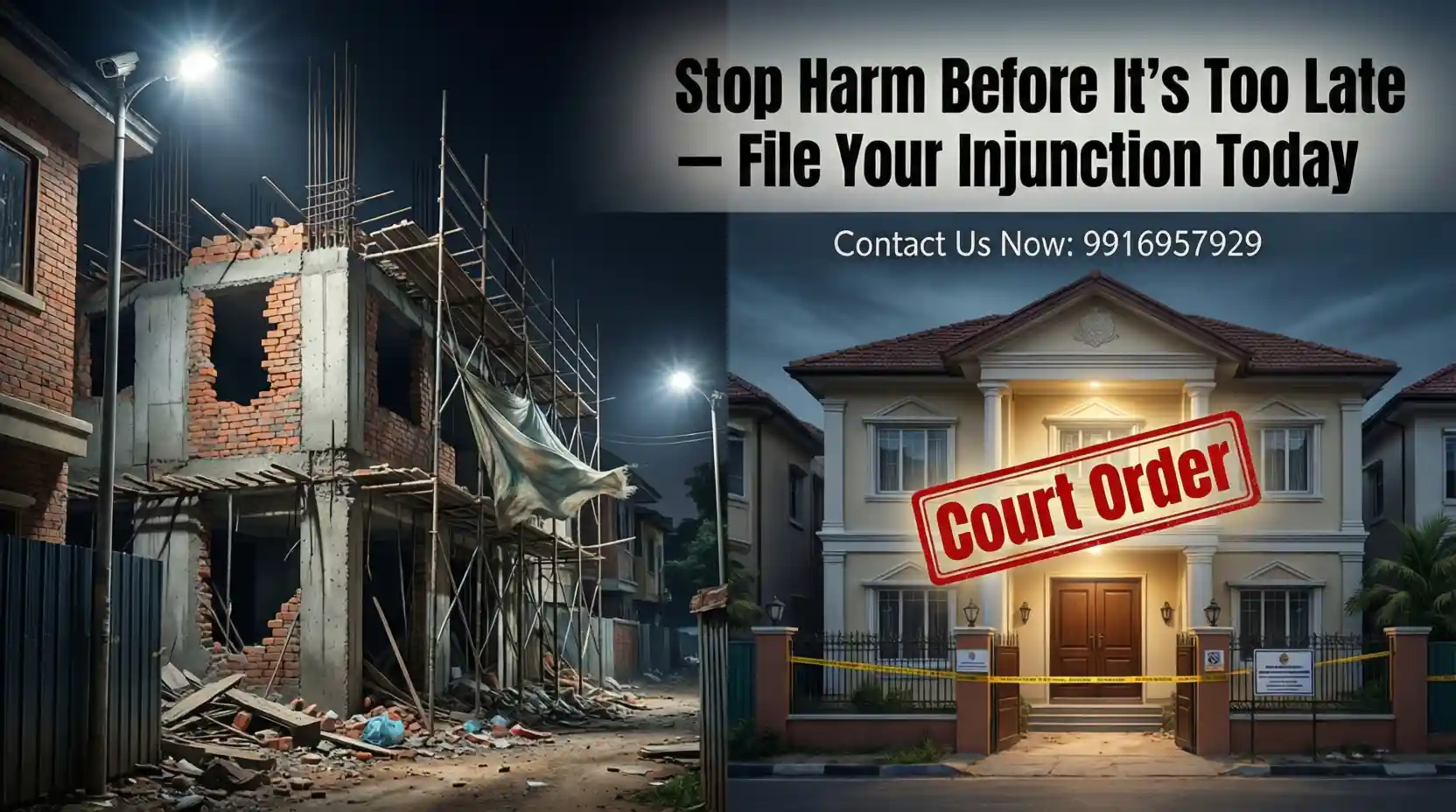
Not every dispute needs an injunction but when you’re facing a situation where waiting could cause irreversible damage, it’s time to act fast. In our work at SP Law Chambers, we’ve seen a sharp rise in injunction requests across Bangalore, especially in three key areas:
1. Property Disputes
Imagine this: Your neighbor in Indiranagar starts building a wall that crosses into your compound. Or a builder in Electronic City begins construction on land you jointly own. Without an injunction, that structure could be completed in weeks and once it’s up, removing it becomes far harder, even if you win the case later. Injunctions help preserve the status quo meaning things stay as they were before the conflict began.
2. Business & Intellectual Property (IP) Conflicts
Startups and small businesses in tech hubs like Whitefield or HSR Layout often face threats like:
- An ex-employee sharing client lists or source code.
- A competitor using your brand name or logo.
- A partner secretly diverting company funds.
In these cases, money alone won’t fix the damage. An injunction can stop the leak, block the copycat product, or freeze assets - giving you breathing room to resolve the issue legally.
3. Family Law Emergencies
During divorce or separation proceedings, one spouse might try to sell off shared property, empty bank accounts, or remove children from school without consent. In Bangalore, we’ve handled multiple cases where a timely injunction prevented asset stripping and ensured fair outcomes in family court.
Here’s a hard truth many clients learn too late: Once the harm happens, it’s often too late. You can’t un-build a floor, un-leak a secret, or un-sell a house. As one of our senior advocates often says, “Injunctions aren’t about winning the war they’re about stopping the battle before your home burns down.”
At SP Law Chambers, nearly 65% of our injunction cases in 2026 came from property emergencies in East and South Bangalore areas seeing rapid development and frequent boundary disputes. If you’re in a similar situation, don’t wait for “the right time.” In emergency legal relief, now is the right time.
The 3 Legal Tests Courts Use to Grant an Injunction in India
You can’t just walk into a Bangalore court and say, “Please stop them!” even if you’re in real trouble. Judges follow strict legal principles before granting any injunction. In fact, under Order XXXIX of the Code of Civil Procedure (CPC), courts must be satisfied on three key grounds before issuing even a temporary injunction. These aren’t suggestions they’re mandatory filters. And if your application fails on even one, it’s likely to be rejected.
Let’s break them down in plain terms:
1. Prima Facie Case
This means you must show that your case has a reasonable chance of winning at trial. You don’t need to prove everything right now but you do need enough evidence to convince the judge that your claim isn’t baseless. For example, if you’re trying to stop illegal construction, you’d need property documents, survey maps, or BBMP notices showing the violation. Without this, the court may say, “Come back when you have proof.”
2. Balance of Convenience
Here, the judge asks: Who will suffer more if I grant or deny the injunction? If stopping the other party causes them minor inconvenience, but not stopping them ruins your business or home, the balance tips in your favor. But if both sides are equally affected, courts often refuse to interfere. As the Supreme Court emphasized in the landmark case Dalpat Kumar v. Prahlad Singh (1992), “The balance must clearly tilt toward the applicant.”
3. Irreparable Injury
This is often the most misunderstood test. It doesn’t mean “big loss” it means loss that money can’t fix. For instance:
- Losing a family heirloom property to encroachment.
- A competitor leaking your startup’s secret algorithm.
- Damage to your professional reputation from false claims.
If you can be fully compensated with money later, the court may say, “Wait for the final judgment.” But if the harm is permanent or unique, that’s when injunctions become essential.
Expert Insight from SP Law Chambers:
“In Bangalore City Civil Court, we’ve seen strong cases get rejected simply because the applicant didn’t send a legal notice first especially when dealing with government bodies or contractual disputes. Under Section 80 of the CPC, a 60-day notice is mandatory before suing the government. Even in private disputes, judges appreciate seeing that you tried to resolve things peacefully before rushing to court.”
These three tests work together like a safety net. Miss one, and the whole application can fall through. That’s why drafting a solid affidavit with clear facts, photos, and supporting documents isn’t just helpful it’s non-negotiable.
At SP Law Chambers, we always run a “3-test checklist” before filing any injunction. It saves time, avoids rejections, and most importantly gives our clients the best shot at getting fast, effective relief when they need it most.
Step-by-Step: How to File for an Injunction in Bangalore Courts
If you’re wondering how to get a temporary injunction in Bangalore, the process might seem overwhelming but it’s manageable when broken into clear steps. At SP Law Chambers, we’ve guided hundreds of clients through this exact path. Here’s how it works in real life, not just in textbooks:
Step 1: Send a Legal Notice
Before filing in court, always consider sending a legal notice especially if your case involves a government body (mandatory under Section 80 CPC) or a breach of contract. Even in private disputes, a well-drafted notice shows the court you tried to resolve things fairly. Many judges in Bangalore view this as a sign of good faith.
Step 2: Draft the Application & Affidavit
Your lawyer will prepare an application under Order XXXIX Rules 1 and 2 of the CPC, supported by a detailed affidavit. This isn’t just a form it must clearly explain the three legal tests (prima facie case, balance of convenience, irreparable injury) and include evidence like photos, documents, or messages.
Step 3: File in the Correct Court
This is where many go wrong. In Bangalore, civil cases are divided by claim value:
- Civil Judge (Junior Division): Handles claims up to ₹10 lakh.
- Civil Judge (Senior Division): For claims above ₹10 lakh.
File in the wrong court, and your case could be delayed by months or even dismissed. As one of our advocates often says, “We’ve seen strong cases stall for over 3 months just because of incorrect jurisdiction.”
Step 4: Attend the Hearing
Most injunction hearings happen within days or weeks. In true emergencies like someone demolishing your wall tonight you can request an ex parte injunction, where the judge hears only your side first. But be honest: if you hide facts, the order can be cancelled quickly.
Step 5: Enforce the Order
Once granted, the injunction is legally binding. If the other party ignores it, you can file for contempt under Order XXXIX Rule 2A CPC which can lead to property attachment or even jail time.
Getting an injunction in Bangalore isn’t just about paperwork it’s about timing, precision, and local know-how. That’s why having a team that knows every courtroom in the city makes all the difference.
Ex Parte & Ad Interim Injunctions: Fast-Track Relief in True Emergencies
Sometimes, waiting even a few days for the other side to respond isn’t an option. Maybe your business partner is about to transfer company funds overseas tonight. Or a builder has started demolishing part of your shared compound wall at dawn. In these true emergencies, the law offers a powerful shortcut: the ex parte injunction.
An ex parte injunction is a temporary court order granted without giving the other party a chance to speak because there’s simply no time. It’s not a loophole; it’s a carefully guarded exception used only when delay would cause serious, irreversible harm.
In Bangalore, courts allow ex parte injunctions in situations like:
- Fraud or deception (e.g., fake property sale deeds),
- Imminent destruction of evidence or property,
- Flight risk (when the opponent might leave the country to avoid justice).
But this speed comes with responsibility and risk. If the other side later proves you hid facts, exaggerated the threat, or misled the court, the judge can cancel the order immediately and even penalize you for misuse.
Insider Tip from SP Law Chambers:
“Since 2024, Karnataka courts including the City Civil Court and High Court have become much stricter. They now expect stronger affidavits with time-stamped photos, WhatsApp screenshots, police complaints, or BBMP notices. A vague statement like ‘I’m scared they’ll build’ won’t cut it anymore.”
At SP Law Chambers, Advocate Geethanjali Setty secured over 20 ex parte injunctions in 2026 alone from stopping illegal constructions in Banashankari to freezing bank accounts in partnership disputes in Koramangala. Her secret? Precision, honesty, and documentation. “We never ask for ex parte unless it’s truly urgent,” she says. “Because once you lose a judge’s trust, it’s hard to get it back.”
Remember: Ad interim just means “temporary until the next hearing.” An ex parte order is often ad interim but not all ad interim orders are ex parte. Knowing the difference helps you set realistic expectations.
Common Mistakes That Get Injunction Applications Rejected in Karnataka
You’ve gathered your documents. You’re stressed. You file your application only to get a rejection letter weeks later. Why? Often, it’s not because your case is weak, but because of preventable errors.
Based on our experience reviewing hundreds of injunction files, here are the top reasons applications get rejected in Bangalore courts:
1. Claiming Only Monetary Loss
Saying “They owe me ₹5 lakh” isn’t enough. Courts won’t grant an injunction if your harm can be fixed with money later. You must show irreparable injury like losing your ancestral home or your startup’s unique client database.
2. Skipping the Legal Notice
If your dispute involves a government department or a written contract, Section 80 CPC requires a 60-day legal notice before filing suit. Even in private matters, judges in Bangalore often ask, “Did you try to settle this first?” Not sending a notice can make your case look rushed or aggressive.
3. Filing in the Wrong Court
As mentioned earlier, Civil Judge (Junior Division) handles claims up to ₹10 lakh; Senior Division takes higher-value cases. File in the wrong one, and your case gets returned or worse, dismissed for lack of jurisdiction. We’ve seen clients lose critical time this way.
4. Weak or Vague Affidavits
An affidavit full of opinions (“He’s a liar!”) but no proof won’t help. Judges want facts + documents: site photos, title deeds, emails, police FIRs, or valuation reports. One client lost their injunction because their affidavit said “my neighbor is building” but had no date-stamped images.
How SP Law Chambers Helps:
“Before we file anything, we audit every draft application checking jurisdiction, evidence strength, and legal phrasing. Last year, this caught 12 errors that would’ve led to rejections. Our goal isn’t just to file fast it’s to file right.”
Avoiding these mistakes doesn’t just improve your chances it shows the court you’re serious, prepared, and respectful of the process. And in emergency relief, that professionalism can be your greatest asset.
Costs, Timelines & Appeals: What to Expect in 2026
If you’re considering an injunction in Bangalore, it’s natural to wonder: How long will this take? How much will it cost? And what if the judge says no? Let’s cut through the uncertainty with real-world expectations for 2026.
Timeline: Speed Depends on Urgency
- Ex parte injunction: In true emergencies, you can get an order in 3 to 7 days sometimes even faster if you have strong evidence like drone footage or police complaints.
- Regular temporary injunction: For non-emergency cases, hearings typically happen within 2 to 8 weeks, depending on court backlog. The City Civil Court in Bangalore is currently managing heavy caseloads, so early filing matters.
Costs: Transparent and Predictable
Court fees for injunction applications usually range from ₹1,000 to ₹10,000, based on the value of the dispute. Lawyer fees vary but at SP Law Chambers, we offer clear, upfront pricing with no hidden charges. Many clients are surprised to learn that emergency legal help doesn’t have to break the bank. We believe fast relief should be affordable.
Appeals: Yes, You Can Challenge the Decision
If your application is rejected or if the other side gets an injunction against you you’re not out of options. Under Order XLIII Rule 1 of the CPC, most interim injunction orders are appealable before the District Judge or Karnataka High Court. Timing is critical: appeals must usually be filed within 30 days.
Looking Ahead: The Karnataka High Court is expected to roll out new IPD (Injunction Procedure Directions) in 2026, modeled after Delhi and Bombay High Courts. These rules could streamline filings, mandate digital evidence formats, and reduce delays making emergency relief even more accessible.
Knowing what to expect helps you plan wisely and act without panic.
Real Injunction Success Stories from SP Law Chambers in Bangalore

At SP Law Chambers, we don’t just handle cases we protect futures. Here are three real (but anonymized) examples from 2025 that show how timely injunctions changed outcomes for our clients across Bangalore:
Property Emergency in Indiranagar
A homeowner discovered her neighbor had started illegal construction of a third floor, casting permanent shadow over her home and violating BBMP norms. We filed an ex parte injunction within 48 hours, supported by drone images and official violation notices. Result: Construction stopped immediately. Five months later, the court granted a permanent injunction, saving her property rights.
Tech Startup Crisis in Whitefield
A young SaaS company learned a former employee was about to share their source code with a competitor. With their entire business at risk, we moved fast. Citing breach of NDA and irreparable intellectual property loss, we secured an ad interim injunction in just 10 days. Result: The ex-employee was legally barred from disclosing any data preserving the startup’s market edge.
Family Asset Protection in Koramangala
During a high-tension divorce, a wife feared her husband would secretly sell their jointly owned home. We filed for a status quo order to freeze all transactions. Result: The asset remained protected, leading to a fair financial settlement without rushed sales or hidden transfers.
Why SP Law Chambers?
Our team including Advocate Geethanjali Setty, with 14+ years in Karnataka courts knows exactly how Bangalore judges think, what evidence they trust, and how to frame arguments for maximum impact. That local expertise turns “maybe” into “yes” fast.
FAQs About Temporary & Permanent Injunctions in Bangalore
If you’re new to civil litigation, injunctions can feel confusing. Here are clear, practical answers to the questions we hear most often at SP Law Chambers based on real cases we’ve handled across Bangalore.
1. What’s the difference between a temporary and permanent injunction in India?
A temporary injunction is a short-term order given while your case is still going on it’s meant to preserve the current situation (called “status quo”) until the court makes a final decision. A permanent injunction, on the other hand, is a final order issued after the full trial ends. It permanently stops someone from doing something, like building on your land or using your brand name.
2. How long does it take to get an injunction in Bangalore courts?
It depends on urgency. In true emergencies (like illegal construction starting tonight), an ex parte injunction can be granted in 3 to 7 days. For regular applications, hearings usually happen within 2 to 8 weeks, though heavy caseloads in City Civil Court can sometimes cause delays.
3. Is a legal notice required before filing for an injunction in Karnataka?
Yes if you’re suing a government body, Section 80 of the CPC requires a 60-day legal notice. Even in private disputes (like property or business conflicts), we strongly recommend sending one. Judges in Bangalore often view it as a sign you tried to resolve things fairly before rushing to court.
4. Can I appeal if my injunction application is rejected?
Absolutely. Under Order XLIII Rule 1 of the CPC, most interim injunction orders can be appealed before the District Judge or the Karnataka High Court usually within 30 days of the order.
5. Why hire a Bangalore-based lawyer for an injunction?
Local knowledge matters. Bangalore courts have their own rhythms, judge preferences, and procedural expectations. A lawyer who appears regularly in these courts knows how to draft stronger affidavits, pick the right court, and present your case in a way that resonates leading to faster, more reliable results.
6. What happens if someone violates an injunction order?
Breaking an injunction is serious. The court can punish the violator for contempt of court under Order XXXIX Rule 2A CPC which may include jail time or attachment of property until they comply. At SP Law Chambers, we’ve successfully enforced injunctions this way for clients in property and business disputes.
Next Steps: Secure Your Emergency Injunction in Bangalore Today

If you’re facing an urgent legal threat whether it’s illegal construction, a business betrayal, or a family asset at risk every hour counts. Here’s what to do right now:
- Document everything: Take dated photos, save messages, collect contracts, and note witness names.
- Do NOT delay: Courts won’t help if you wait until the damage is done.
- Avoid DIY filings: A small error in court selection or affidavit wording can get your case rejected for months.
- Consult a specialist: Especially for ex parte requests or complex commercial disputes local expertise makes all the difference.
Get Fast, Affordable Legal Help from SP Law Chambers
With 14+ years in Karnataka courts and 1,500+ satisfied clients, Advocate Geethanjali Setty and her team offer same-day consultation and transparent, nominal fees no surprises, no pressure.
Book Your Free 15-Minute Strategy Call Today and take control before it’s too late.
Conclusion
Temporary and permanent injunctions are among the most powerful tools in civil law but only if applied correctly and quickly. In Bangalore’s fast-moving legal landscape, success hinges on understanding the three legal tests, avoiding common filing errors, and acting before irreparable harm occurs. At SP Law Chambers, our decade-plus experience in Karnataka courts, client-first approach, and track record of 1,500+ successful cases make us your trusted partner for emergency relief. Don’t wait until it’s too late protect your rights today with expert legal guidance you can rely on.

Advocate Geethanjali Setty is the driving force behind SP LAW CHAMBERS. With over 14 years of hands-on legal experience, she is known for her ethical, result-oriented approach. Geethanjali is registered with the Bar Council of Karnataka and has built a reputable practice offering comprehensive legal consultancy and advisory services. She and her team of six dedicated advocates handle a wide range of legal matters with integrity and efficiency.
At SP LAW CHAMBERS, clients receive not just legal expertise, but also a commitment to clear, client-focused guidance. Geethanjali’s focus on client satisfaction and her proven track record make her a trusted name in the Bangalore legal community.