
1‑Minute Read Summary
This guide provides a professional legal notice format for India, updated for 2026, covering essential components like cause of action and relief sought. It is designed to help individuals who need a demand letter format to recover money or resolve contract breaches quickly. The key takeaway is that while templates offer a starting point, professional oversight from a demand notice lawyer in Bangalore is crucial to ensure your notice is both legally binding and strategic.

Introduction
Receiving or sending a legal notice is often a critical moment in a civil dispute. For a business owner in Bangalore chasing unpaid invoices or an individual navigating a property disagreement, a well-crafted demand notice can resolve the conflict without needing a lengthy court battle. In the Indian legal landscape, a legal notice is a formal, written communication sent to an opponent, clearly stating your intention to initiate legal proceedings against them.
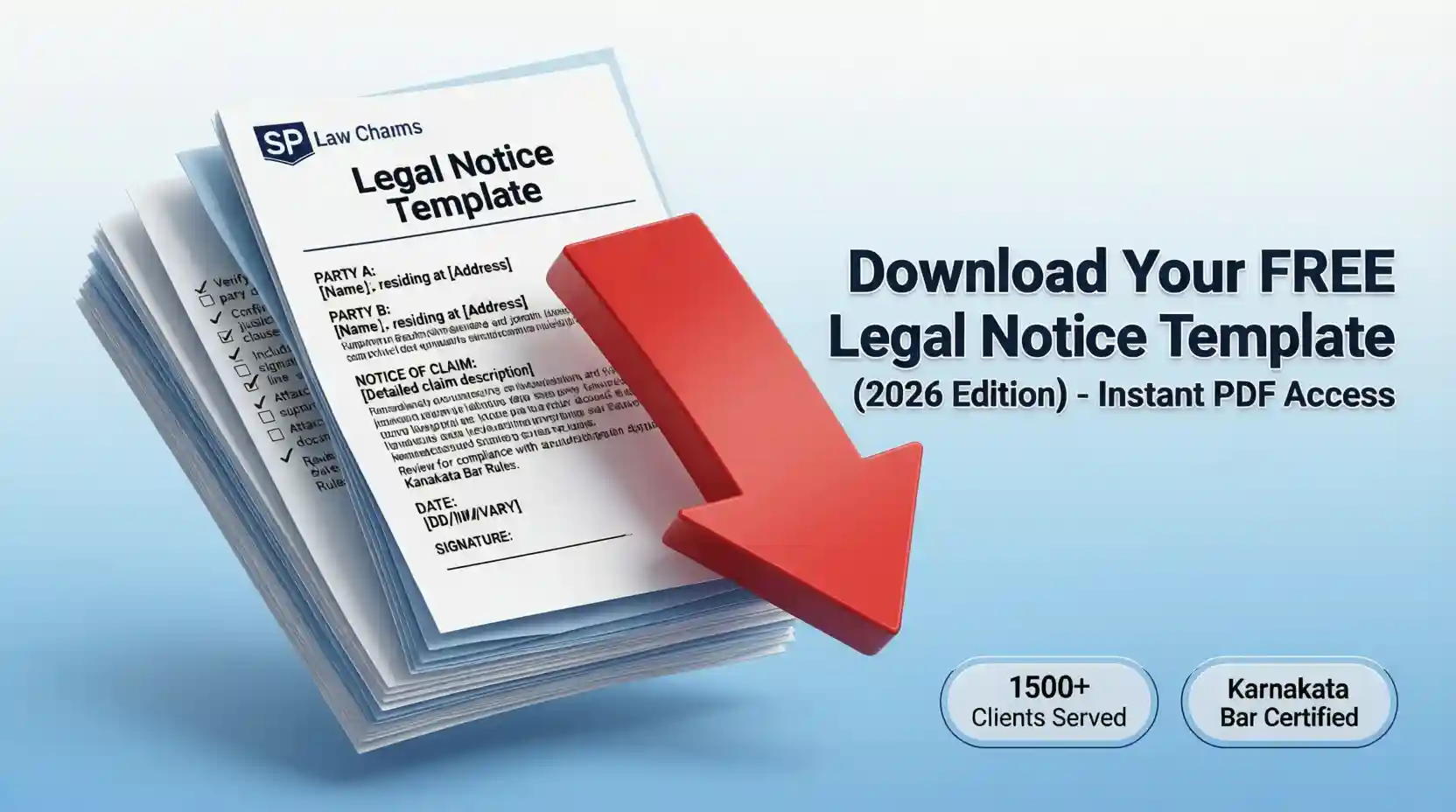
The importance of a properly drafted notice cannot be overstated. With 2026 regulatory updates and evolving Karnataka Bar Council standards, using an outdated format can significantly weaken your case before it even begins. This guide will provide you with a free legal notice template PDF, explain the key differences between a legal notice and a demand notice, and walk you through the step-by-step drafting process used by the experts at SP Law Chambers.
What is a Legal Notice? Understanding the Demand Letter Format
At its core, a legal notice is your final warning shot before taking a fight to the courtroom. Think of it as a “precursor to litigation.” It is a formal written document sent by an aggrieved party (or their lawyer) to the person or entity causing them trouble. Under the Code of Civil Procedure (CPC) in India, this notice signals that you are serious about resolving the issue and are prepared to sue if things don’t get fixed.
It serves a dual purpose: it gives the other side a chance to resolve the dispute amicably without the hassle of court, and it creates a paper trail proving you tried to solve the problem fairly.
Demand Letter vs. Section 80 Notice
While people often use terms like “demand letter” and “legal notice” interchangeably, there is a technical difference depending on who you are fighting.
- Demand Letter Format: This is what you typically send in private disputes—like recovering money from a friend, a tenant dispute, or a breach of contract with a vendor. It clearly demands performance (pay the money, vacate the house, etc.) within a specific timeframe.
- Section 80 Notice (CPC): This is a mandatory requirement if you intend to file a suit against the Government or a Public Officer. The law requires you to give them a specific “heads-up” (usually 60 days) to correct their actions before you can drag them to court. You cannot just surprise the government with a lawsuit; the Section 80 notice is the non-negotiable first step.
Expert Insight
Why does the drafting matter so much? It’s not just about scaring the opponent.
Advocate Geethanjali Setty from SP Law Chambers explains:
“A notice is not just a letter; it is a piece of evidence that stays with your case until the final judgment.”

This means if your notice is weak or missing key facts, you can’t just “fix it” later in court. What you say now becomes the foundation of your entire legal battle.
When to Issue a Legal Notice: Timeline & Legal Requirements
Knowing the right time to send a legal notice is crucial. Acting too soon might seem overly aggressive, but waiting too long can harm your case. The timing often depends on the specific issue you’re facing. For example, in a cheque bounce case under the Negotiable Instruments Act, you have a strict window. You must send the notice to the person who issued the bad cheque within 30 days of it being dishonored by the bank. They then get 15 days to pay up. For other issues, like property disputes or contract breaches, the timeline isn’t as rigid, but it’s always wise to act promptly once you realize the other party isn’t cooperating.
Sending a demand notice is often the smartest first move for several reasons. It shows you mean business and are prepared to escalate the matter, which can prompt a quick settlement. It also serves as a formal record that you tried to resolve the issue out of court, which judges look upon favorably. Most importantly, it can save you a significant amount of time and money by avoiding a lengthy and expensive court case altogether.
Is a Legal Notice Mandatory in India?
This is a common question, and the answer is: it depends. For most private civil disputes, such as recovering money from a client or dealing with a faulty product, sending a legal notice is not legally required. You could technically file a lawsuit directly. However, it is almost always recommended as a best practice.
There are, however, specific situations where sending a legal notice is mandatory. The most notable example is if you plan to sue the government or a public officer for an act committed during their official duties. Under Section 80 of the Code of Civil Procedure, you must provide them with a notice and wait for a specified period (usually two months) before you can file a suit. Failing to do so can get your case dismissed on technical grounds. Similarly, laws governing landlord-tenant disputes or cheque bounce cases also have specific notice requirements that must be met.
How to Draft a Legal Notice: Components of an Effective Template
Drafting a legal notice isn’t about using complicated legal words to sound intimidating. It’s about clear, factual, and firm communication. A strong notice has a logical structure that tells the whole story from start to finish.
The essential parts of a standard legal notice include:
- Parties’ Details: This is the “who’s who” of the dispute. The notice must clearly state the full name, address, and description of both the sender (you) and the recipient (the other party). Accuracy here is non-negotiable.
- Factual Summary: This section lays out the story. You need to present a clear, chronological account of the facts that led to the dispute. For example, if it’s about an unpaid invoice, you would mention the date the service was provided, the invoice number, the due date, and any follow-up attempts you made. Stick to the facts and avoid emotional language.
- Cause of Action: This is the legal heart of your notice. It explains why you have the right to take legal action. It pinpoints the specific act or omission by the other party that caused you harm and violated your rights. For instance, the “cause of action” in a cheque bounce case arises the moment the bank returns the cheque unpaid.
- The Relief (Your Demand): This is the “what you want” part. You must be very specific about what the other party needs to do to resolve the matter. This could be a demand for a specific sum of money, the return of property, or an apology. You also need to state the deadline for them to comply, typically 15 or 30 days.
Regarding formatting, an advocate’s legal notice should always be printed on their professional letterhead. This immediately signals that the communication is serious and comes with legal authority.
Best Way to Send a Legal Notice in Bangalore
Once your notice is drafted, how you send it is just as important as what it says. You need proof that the other party received it. In Bangalore, and across India, the gold standard for this is Registered Post with Acknowledgement Due (RPAD).
When you send a notice via RPAD, the post office provides you with a receipt. More importantly, the recipient has to sign an “Acknowledgement Due” card upon delivery, which is then returned to you. This signed card is solid proof of delivery that is recognized and respected in Karnataka courts. It prevents the other party from later claiming they “never got the notice.”
Common Use Cases for Legal Notice Templates in 2026
A legal notice is a versatile tool used across many different types of disputes. While the core purpose remains the same—to formally communicate a grievance and demand a resolution—the context can vary significantly. Having a reliable template is a great starting point for some of the most frequent issues individuals and businesses face. If you’re facing criminal allegations and need urgent protection, learn about anticipatory bail procedures in Bangalore.
Common scenarios where a legal notice is the first step include:
- Recovery of Money: This is perhaps the most common use. Whether it’s for unpaid invoices, a personal loan to a friend that was never returned, or outstanding salary dues from an employer, a
legal notice for recovery of money formatis used to demand payment before filing a civil suit. - Breach of Contract: When one party fails to uphold their end of a signed agreement, a
breach of contract templateis sent. It outlines which clause was violated and what action is needed to fix the breach, such as completing the work or providing compensation. - Tenant Eviction: For landlords dealing with tenants who haven’t paid rent or have violated the rental agreement, a
tenant eviction noticeis a mandatory first step before initiating eviction proceedings in court. - Banking and Finance: In the financial sector, there are specific notices governed by powerful laws. For instance, banks and financial institutions issue a
demand notice under the SARFAESI Actto borrowers who default on secured loans, initiating the process of repossessing the asset (like a house or car) without court intervention.
Legal Notice for Property Disputes in Bangalore
Bangalore’s dynamic real estate market often leads to complex property disputes. Sending a legal notice here requires an understanding of local laws, as generic templates might not cover all bases. Property issues are governed not just by central acts but also by Karnataka-specific regulations like the Karnataka Land Revenue Act and the Karnataka Property Tax Rules.
For example, if you’re dealing with a dispute over ancestral property, encroachment by a neighbor, or a builder delaying possession of a flat, your legal notice must be precise. It should reference the correct legal provisions and clearly state the history of ownership and the nature of the dispute. Given the high stakes of real estate in Bangalore, a notice drafted by a lawyer familiar with the local landscape ensures you start your case on solid legal ground, addressing all nuances of Karnataka’s property laws from the very beginning.
Expert Drafting: Common Mistakes to Avoid
Drafting a legal notice might seem like a simple writing task, but in the legal world, every word carries weight. A single mistake in your initial notice can haunt you months later if the case goes to court. At SP Law Chambers, having guided over 1,500 satisfied clients through successful resolutions, we have identified a pattern of errors that often ruin a good case before it even starts.
Here is how you can avoid these pitfalls using expert strategies.
The “Zero-Ambiguity Framework”
The biggest enemy of a strong legal notice is contradiction. To combat this, we use what we call the “Zero-Ambiguity Framework.”
Ambiguity happens when your story isn’t clear or when facts don’t match up. For example, imagine you write in paragraph one that you lent money to a friend on “January 1st.” But later, in paragraph four, you mention that he promised to return the money “a week after the New Year’s party on January 5th.”
These small slip-ups might seem harmless now, but they are dangerous. If your case goes to trial, the opposing lawyer will use these contradictions during cross-examination (when they question you in front of a judge). They will use that one tiny error to claim that your entire story is unreliable. The Zero-Ambiguity Framework ensures that every date, amount, and fact in your notice is 100% consistent, giving the opponent no room to attack your credibility.
The Risk of Copy-Paste Templates in Bangalore
The internet is full of free templates, but using them blindly is a major risk, especially for property matters in Bangalore. Real estate laws change from city to city, and a generic template usually lacks local context.
For instance, a standard template might mention “municipal records.” However, in Bangalore, the specific terminology matters. Dealing with the BBMP (Bruhat Bengaluru Mahanagara Palike) regarding Khata transfers or the BDA (Bangalore Development Authority) regarding site allotments requires specific legal language.
If your notice cites a general national law but ignores the specific Karnataka State act relevant to your property, it signals to the other side that you are unprepared. A customized notice that correctly references local authorities like the BBMP shows that you are serious, knowledgeable, and ready to fight legally.
FAQ: Frequently Asked Questions
Understanding legal notices can be tricky, especially with so many rules involved. Here are the answers to the most common questions our clients at SP Law Chambers ask us.
1. How much does it cost to send a legal notice in Bangalore?
The cost can vary significantly. If you draft and send it yourself, you only pay for printing and the Registered Post (RPAD) charges, which are quite nominal—usually under ₹100. However, hiring a professional lawyer involves drafting fees. While this costs more than doing it yourself, you are paying for professional value. A lawyer ensures the legal language is watertight, calculates interest correctly, and cites the right laws. Think of it as an investment: a small fee now to avoid losing a big case later.
2. Can I send a legal notice without a lawyer?
Yes, you absolutely can. In legal terms, this is called appearing as a “party-in-person.” You have every right to draft and send your own notice. However, there is a catch. A notice sent on an advocate’s letterhead carries the “weight of an advocate’s signature.” It often signals to the other party that you have already consulted a legal expert and are serious about taking the matter to court. This psychological impact often leads to faster settlements than a personal letter.
3. What happens if a legal notice is ignored by the recipient?
Ignoring a legal notice is risky for the recipient. If they don’t reply within the specified time, you can proceed to file a case in court. When the judge sees that the other party ignored your formal notice, it strengthens your position. It shows the court that you tried to be fair, but they were non-compliant. In some cases, if they ignore the court summons later on as well, the court may pass an ex-parte order, which means the judge decides the case in your favor simply because the other side didn’t show up to defend themselves.
4. Can a legal notice be sent by email or WhatsApp in 2026?
Yes! The Indian legal system has modernized. Recent rulings by the Supreme Court of India have recognized digital service of notices. If you send a notice via email or even WhatsApp, and you can prove that the “blue ticks” appeared (meaning it was read), courts increasingly accept this as valid delivery. For businesses in the fintech or startup sector, digital documentation of notices aligns with modern compliance requirements.
5. How long does the recipient have to reply?
There is no single rule for every case, but the standard window is usually 15 to 30 days.
- Cheque Bounce Cases: The law strictly gives the recipient 15 days to make the payment.
- General Disputes: For property or contract issues, giving 30 days is standard practice to show you are being reasonable.
The notice itself will clearly state the deadline you are setting for them.
6. What should I do if I receive a legal notice?
First, do not panic. Second, do not ignore it. Ignoring it won’t make it go away; it just makes it worse. Read the notice carefully to understand exactly what the other person is claiming. You should then consult a lawyer to draft a proper Reply to Legal Notice. This reply is your chance to tell your side of the story and deny any false accusations. A strong, timely reply can often stop a lawsuit before it even happens.
Conclusion
In the end, having access to a free legal notice template is an excellent starting point for resolving disputes in 2026. However, simply filling in the blanks isn’t enough; the strategy behind your notice is what truly determines the outcome. A well-drafted notice does more than just state facts—it tells a compelling story that compels the other side to listen.
By focusing on the correct demand notice format and avoiding common drafting errors, you significantly increase your chances of securing a favorable out-of-court settlement without the stress of a trial. While templates provide the structure, professional insight provides the strength. Trust the 14 years of expertise at SP Law Chambers Bangalore to guide you through this process. We ensure your legal advocacy is precise, strategic, and as effective as our proven track record suggests. Don’t just send a letter; send a message that gets results.

Advocate Geethanjali Setty is the driving force behind SP LAW CHAMBERS. With over 14 years of hands-on legal experience, she is known for her ethical, result-oriented approach. Geethanjali is registered with the Bar Council of Karnataka and has built a reputable practice offering comprehensive legal consultancy and advisory services. She and her team of six dedicated advocates handle a wide range of legal matters with integrity and efficiency.
At SP LAW CHAMBERS, clients receive not just legal expertise, but also a commitment to clear, client-focused guidance. Geethanjali’s focus on client satisfaction and her proven track record make her a trusted name in the Bangalore legal community.