
1-Minute Read
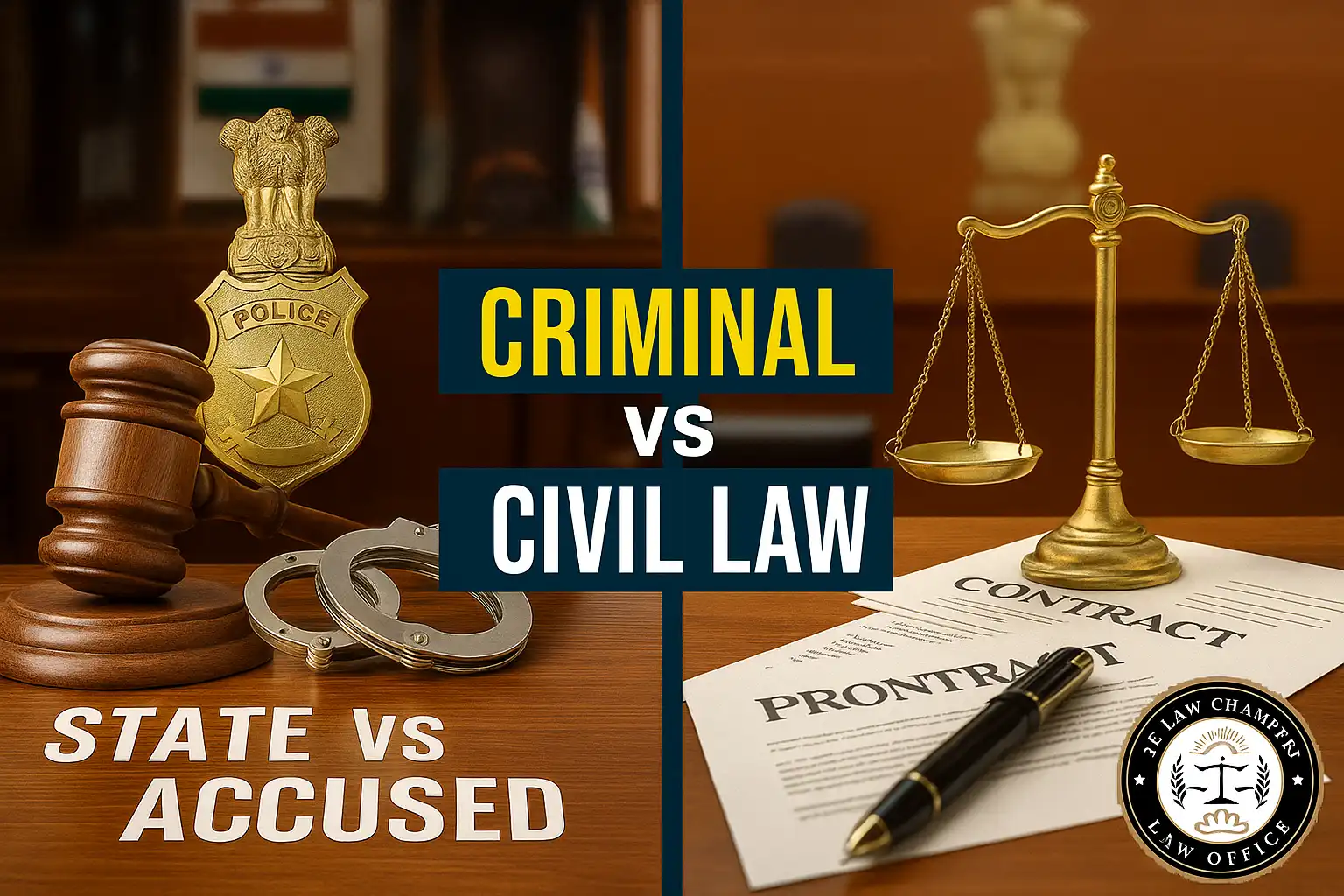
What is the difference between criminal and civil law? Criminal law deals with acts that are considered offenses against society as a whole, like theft or assault. The goal is to punish the wrongdoer and protect the public. Civil law, on the other hand, handles private disputes between individuals or organizations, such as arguments over property or contracts. Its purpose is to compensate the wronged party.
Here are the key differences:
- Purpose: Criminal law punishes, while civil law provides remedies like compensation.
- Parties: It’s the State vs. an accused person in criminal law, and a plaintiff vs. an defendant in civil law.
- Outcome: Criminal cases can lead to fines or imprisonment. Civil cases result in damages or court orders.
- Proof: Criminal cases require proof “beyond a reasonable doubt,” a very high standard. Civil cases need a “preponderance of evidence,” meaning it’s more likely than not that the claim is true.

Understanding the criminal vs civil law distinction in Bangalore is crucial. SP Law Chambers helps you decide whether your dispute is civil, criminal, or both, and which court process is right for you.
Navigating the legal world can feel like learning a new language. For individuals and businesses in Bangalore facing a dispute, one of the first and most confusing questions is whether their issue falls under criminal or civil law.
The path you take can dramatically change the outcome, the process, and the stakes involved. This guide explains the fundamental criminal law vs civil law differences, helping you understand where your case might fit.
We will break down the fundamentals of criminal and civil law, explore the court systems and procedures for each, and provide practical examples to make the concepts clear. We will also touch on how legal reforms affect both areas of law.
This article will clarify the criminal law and civil law difference so you can make informed decisions. Since 2019, SP Law Chambers has guided over 1500 clients through complex legal challenges, leveraging more than seven years of collective expertise. Whether you need a criminal defense lawyer for a serious charge or a civil litigation lawyer for a property dispute, understanding the difference between criminal and civil law is the first step.
What Is Criminal Law?
Criminal law is the body of law that relates to crime. It involves actions that are seen as harmful to society as a whole, not just to an individual victim. When a crime is committed, it is the government—the State—that takes legal action against the alleged wrongdoer.
Definition and Purpose of Criminal Law
Criminal law defines conduct that is prohibited by the state because it threatens public safety and welfare. The primary purpose is not to compensate the victim, but to punish the offender and maintain social order. The main objectives include:
- Punishment: Imposing penalties on those who commit crimes.
- Deterrence: Discouraging the offender and others from committing similar acts in the future.
- Rehabilitation: Helping offenders become law-abiding citizens.
- Protection of Society: Removing dangerous individuals from the community.
In criminal law, the matter is an offense vs a claim. An offense is a public wrong that leads to criminal charges brought by the State. This is different from a private claim made by one person against another. The outcome often involves punishment in criminal cases, such as jail time or fines.
How the Criminal Court System Works
In India, the criminal court system is structured to handle different levels of offenses. Cases typically start in the lower courts, like Magistrate Courts, which handle less serious crimes. More severe offenses are tried in the Sessions Court. Appeals from these courts can go to the High Court and eventually the Supreme Court.
Legal jurisdiction in criminal matters is generally determined by where the offense took place. The local police station in that area will register the case and begin the investigation. The type of offense also determines which court has the authority to hear the case.
Role of the State and the Accused
In a criminal case, the two parties are the State (represented by a public prosecutor) and the accused person. Even if an individual was the victim of the crime, they act as a witness for the prosecution. The State takes on the responsibility of proving the case.
A core principle is the presumption of innocence—the accused is considered innocent until proven guilty. The concept of guilt in criminal court is central, and the burden of proof criminal lawyers for the prosecution must meet is very high. An accused person has the right to legal representation from a criminal defense lawyer to protect their rights throughout the process.

What Is Civil Law?
Civil law governs the disputes between private parties. These parties can be individuals, businesses, or other organizations. Unlike criminal law, which focuses on public wrongs, civil law is concerned with protecting private rights and providing remedies when those rights are violated.
Definition and Purpose of Civil law
Civil law is designed to resolve non-criminal disputes. Think of disagreements over contracts, property, or family matters. The main goals of civil law are:
- Compensation: Ordering one party to pay money (damages) to the other to make up for a loss.
- Enforcement of Rights: Ensuring that a person’s legal rights are respected.
- Specific Relief: Forcing a party to perform a specific action, like fulfilling a contract.
- Declarations: Having a court officially declare the rights of the parties involved.
While criminal law deals with offenses, civil law handles civil disputes. There is a clear distinction between civil and criminal law in their purpose. Civil law aims to put the wronged party back in the position they were in before the harm occurred.
Civil Court System and Jurisdiction
The civil court hierarchy in India generally starts with the Court of Civil Judge (Junior and Senior Division). More significant cases or appeals are heard by the District Court. Above that are the High Court and the Supreme Court.
Legal jurisdiction in civil law is more complex and can be based on several factors:
- Territorial: Where the defendant lives or where the dispute occurred.
- Pecuniary: The monetary value of the lawsuit.
- Subject Matter: The type of case (e.g., family courts handle divorces).
The rules of civil procedure guide how these cases move through the court system. A skilled civil litigation lawyer understands how to establish the correct jurisdiction for a case.
Claims, Parties, and Remedies
In a civil lawsuit, the person who files the case is called the plaintiff. The person or entity being sued is the defendant. The plaintiff makes a claim against the defendant, alleging that their rights have been violated.
If the plaintiff wins, the court can award various remedies. The most common is damages in civil cases, which is a monetary payment. Other remedies include:
- Injunctions: A court order preventing a party from doing a specific act.
- Specific Performance: An order requiring a party to complete their obligations under a contract.
- Declarations: A binding statement from the court about the parties’ rights.
Evidence is key to proving liability in civil court. The rules for court evidence admissibility determine what information the judge can consider when making a decision on these civil disputes.
Criminal Law vs Civil Law: Core Differences (Simple Breakdown)
Understanding the core differences helps to satisfy the intent behind queries like “criminal law vs civil law difference between” and “difference between civil and criminal law with examples.” Let’s break it down simply.
Nature of Wrong Public Offence vs Private Dispute
The most fundamental difference lies in the nature of the wrong. Criminal law addresses actions considered harmful to society as a whole, or a “public wrong.” Even with a single victim, the crime is seen as an offense against the State. A physical assault is a crime against public order and safety.
Civil law, however, deals with “private disputes.” These are wrongs committed by one individual or entity against another, infringing on their private rights. A breach of a rental agreement, for example, is a private dispute between a landlord and a tenant.
Parties and Who Starts the Case
This section helps with the criminal law civil law comparison. In a criminal case, the proceedings are initiated by the State. The parties are the State (represented by the prosecutor) versus the Accused. The victim is a witness, not a party who controls the case.
In a civil case, the person whose rights were violated, the Plaintiff, starts the case by filing a lawsuit. The parties are the Plaintiff versus the Defendant. The government is not directly involved, acting only as the forum (the court) for resolving the dispute. The use of civil and criminal law terms defines the entire structure of the case.
Purpose and Outcome Punishment vs Compensation
The objectives are completely different. The goal of criminal law is punishment in criminal cases. This can include imprisonment, fines paid to the government, or other penalties designed to punish the offender and deter future crime.
The purpose of civil law is to provide a remedy, usually compensation. The most common outcome is an award of damages in civil cases, where the defendant pays money to the plaintiff. Other outcomes include injunctions or declarations that establish rights, but the goal is to resolve the dispute and restore the plaintiff, not to punish the defendant. This highlights the difference in liability in civil court versus guilt in criminal court.
Burden and Standard of Proof
This is a critical legal distinction.
- Criminal Law: The burden of proof criminal cases require is on the prosecution. They must prove the accused’s guilt “beyond a reasonable doubt.” This is a very high standard, meaning the judge or jury must be virtually certain of the accused’s guilt.
- Civil Law: The burden of proof is on the plaintiff. They must prove their case on a “preponderance of evidence,” also known as the “balance of probabilities.” This is a lower standard, meaning it must be more likely than not (over 50% likely) that the plaintiff’s claim is true.
Procedure and Speed
The procedures are distinct. Criminal procedure usually starts with a First Information Report (FIR) or complaint, followed by a police investigation, the filing of a charge sheet, and then a trial.
Civil procedure begins with the plaintiff filing a “plaint.” The court then sends a summons to the defendant, who files a “written statement” in response. The court frames the issues, both sides present evidence, and then arguments are made before a judgment is passed. It is important to note that sometimes, the same set of facts can lead to parallel criminal and civil cases.
Read More:
Examples of Criminal vs Civil Law in Bangalore
To make it practical, here are some scenarios that illustrate the criminal vs civil law in Bangalore:
- Neighbor Dispute: If a neighbor physically assaults you, you can file a police complaint, leading to criminal charges. If that same neighbor builds a wall that encroaches on your property, you would file a civil suit for a property boundary dispute.
- Cheque Bounce: A bounced cheque is a common example of an overlap. You can file a criminal complaint under the Negotiable Instruments Act. At the same time, you can file a civil recovery suit to get your money back.
- Business Fraud: If a business partner forges documents to take money from the company, this can lead to criminal charges for fraud and forgery. Separately, the company can file a civil suit to recover the stolen funds.
In 2026 How Criminal and Civil Procedures Differ Step-by-Step
A closer look at the procedural steps for both types of law reveals how different the legal journeys can be. Understanding these processes helps you appreciate the roles of criminal and civil lawyers.
Snapshot of Criminal Procedure in India

The criminal procedure is primarily governed by the Code of Criminal Procedure (CrPC). A typical case follows these steps:
- Complaint/FIR: The process begins when a complaint is made to the police, resulting in a First Information Report (FIR) for serious offenses.
- Investigation: The police gather evidence, question witnesses, and identify suspects.
- Arrest: In some cases, the police may arrest the accused to prevent them from fleeing or tampering with evidence.
- Charge Sheet/Closure Report: After the investigation, the police file a charge sheet in court if they find evidence, or a closure report if they do not.
- Cognizance by Court: The magistrate takes “cognizance” of the offense, officially starting the court case.
- Trial and Judgment: The court hears evidence from both the prosecution and defense. The rules of court evidence admissibility are strictly followed. The trial concludes with a judgment of either conviction or acquittal.
Snapshot of Civil Procedure in India
The civil procedure is outlined in the Code of Civil Procedure (CPC). This process is designed to handle civil disputes methodically:
- Plaint Filing: The plaintiff files a formal document called a plaint, which details their claim and the remedy sought.
- Summons: The court issues a summons to the defendant, officially notifying them of the lawsuit.
- Written Statement: The defendant responds with a written statement, admitting or denying the claims.
- Framing of Issues: The court identifies the key points of disagreement that need to be decided.
- Evidence: Both parties submit evidence, usually through affidavits, and witnesses may be cross-examined.
- Arguments and Decree: Lawyers for both sides present their final arguments. The court then issues a decree, which is the final judgment. Effective legal representation is crucial at every stage.
Role of Lawyers: Criminal Defense vs Civil Litigation
A criminal defense lawyer focuses on protecting the accused’s rights from the moment of the investigation. They handle bail applications, challenge the prosecution’s evidence, and represent the accused during trial. Their primary goal is to secure an acquittal or minimize the punishment.
A civil litigation lawyer focuses on strategy to win a favorable remedy for their client. They draft legal documents, negotiate settlements, and argue for injunctions or damages. Their work involves long-term strategic planning for property disputes, service matters, or family/divorce cases. SP Law Chambers excels in all these practice areas.
Amendments and Legal Reforms Why the Difference Keeps Evolving
Laws are not static; they change to reflect societal needs and values. Recent amendments and reforms have impacted both criminal and civil law, making it essential to have current legal advice.
Criminal Law Reforms Tougher Punishments and New Offences
Recent criminal law amendments in India have focused on several key areas. New laws have been introduced or old ones have been redefined to address modern challenges like cyber crimes and to strengthen protections, especially regarding sexual offenses. These changes can affect how an offense is classified, the possibility of getting bail, and the potential sentence if convicted. This constant evolution is why relying on outdated information can be risky.
Civil Law Developments Speed and Alternative Dispute Resolution
In civil law, the trend is towards making the system faster and more efficient. There is a strong push for Alternative Dispute Resolution (ADR) mechanisms like Lok Adalats, mediation, and arbitration. These methods help resolve disputes outside the traditional court system, saving time and money. Procedural rules in civil courts are also being tightened to reduce the massive backlog of cases. While the core ideas of liability and compensation remain, the ways to achieve them are changing.
Why You Need Updated Legal Advice
Because laws and procedures are constantly being updated, what was true a few years ago might not be accurate today. Online articles can become outdated quickly. This is why consulting with a law firm like SP Law Chambers, which stays current with legal developments in both civil and criminal matters, is so important for protecting your interests.
When One Dispute Becomes Both Civil and Criminal
Some of the most complex legal situations arise when a single incident gives rise to both civil and criminal proceedings. Handling these overlaps requires a careful and coordinated legal strategy.
Common Overlaps in Real Life
Many real-life situations have both civil and criminal components. Here are a few common examples:
- Domestic Violence: An act of domestic violence can lead to a criminal case against the abuser. At the same time, the victim can file for divorce, child custody, and maintenance in a civil/family court.
- Cheque Bounce: As mentioned earlier, a bounced cheque can trigger a criminal complaint for the offense and a civil suit for the recovery of the money.
- Property Fraud: Someone forging documents to sell your property is a criminal act (fraud, forgery). You would also need to file a civil suit to have the fraudulent sale canceled and declare your ownership (title).
In these cases, the legal strategy must carefully consider both court tracks.
Risks of Choosing the Wrong Path
Failing to understand the dual nature of a case can lead to significant problems. You might face delays, file your case in the wrong court (forum), miss deadlines (limitation issues), and waste a lot of money. For instance, filing only a criminal complaint for fraud might punish the wrongdoer, but it won’t necessarily get your money or property back. Conversely, filing only a civil suit might provide compensation but won’t offer the immediate protection or deterrence that a criminal case can.
How SP Law Chambers Designs a Combined Strategy
At SP Law Chambers, we specialize in creating a unified strategy for these complex cases. Our approach includes:
- Case Triage: We first analyze your situation to determine if it is criminal, civil, or both.
- Sequence Planning: We advise on the best order to file the cases—sometimes a criminal action should come first, and other times a civil suit is the priority.
- Coordinated Litigation: We manage the litigation in different courts to ensure that the actions in one case support the goals in the other.
As your trusted legal experts in Bangalore, we navigate the entire court system to provide comprehensive legal representation.
How SP Law Chambers Helps You Decide Criminal or Civil?
Making the right legal move from the start is critical. SP Law Chambers provides the clarity and expertise you need to navigate the complexities of the legal system in Bangalore.
Our Experience Across Criminal and Civil Matters in Bangalore
Established in 2019, SP Law Chambers brings together a team with over seven years of collective experience. We have successfully represented more than 1500 clients in a wide range of cases, including divorce, criminal defense, property disputes, and service matters. Whether you need a top criminal defense lawyer in Bangalore or a strategic civil litigation lawyer in Bangalore, our firm has the proven expertise to guide you.
When to Speak to a Criminal Defense Lawyer
You should seek a consultation immediately if you are facing any of these situations:
- An FIR has been filed against you.
- The police have called you for an investigation.
- You believe you are at risk of being arrested.
- You need to apply for bail.
- You have been accused of a serious offense.
Early consultation with a lawyer can significantly reduce your risk and help protect your rights.
When to Speak to a Civil Litigation Lawyer
Consult a civil lawyer for issues related to:
- Disputes over property ownership or boundaries.
- Unpaid invoices or business debts.
- Breaches of contract.
- Division of family property.
- Disputes related to your employment (service matters).
A civil lawyer helps you with strategy, documentation, and securing long-term remedies to protect your rights and assets.
If you are unsure about the legal nature of your problem, don’t guess. The right advice can save you time, money, and stress. Request a consultation with our expert team to understand if your matter is civil, criminal, or both. We can help you understand the complex world of criminal law vs civil law and find the best path forward.

Contact SP Law Chambers today. Call or WhatsApp us, or fill out the form on our website to schedule your consultation.
FAQ Difference Between Criminal and Civil Law
What is the basic difference between criminal law and civil law with examples?
The basic difference is their purpose and who is involved. Criminal law deals with offenses against society (e.g., theft, assault) and aims to punish the offender. The case is brought by the State. Civil law handles private disputes between individuals (e.g., a contract breach, a property line dispute) and aims to compensate the wronged party. Understanding the difference between civil and criminal law with examples helps clarify that one is about public wrongs and the other about private rights.
What is the difference between criminal law and civil law in India?
In India, the key difference lies in the objective and procedure. Criminal law, governed by the Indian Penal Code and Code of Criminal Procedure, focuses on punishing crimes against the state, with a high burden of proof (“beyond a reasonable doubt”). Civil law, governed by the Code of Civil Procedure, aims to resolve disputes between private parties over rights and obligations, with a lower burden of proof (“preponderance of evidence”). That is what is the difference between criminal law and civil law in India.
Can one incident lead to both criminal and civil cases?
Yes, absolutely. A single incident can have both criminal and civil consequences. For example, a drunk driving accident can lead to criminal charges against the driver for reckless driving. Simultaneously, the injured victim can file a civil lawsuit against the driver to claim monetary compensation for medical bills and other damages.
Is criminal law more serious than civil law?
“Serious” depends on the context. Criminal law is often seen as more serious because the potential outcome includes loss of liberty (imprisonment), which is a severe punishment. However, civil law should not be trivialized. A large financial judgment in a civil case can be financially devastating for an individual or a business, and court orders can profoundly impact a person’s life and rights.
How do I know whether I need a criminal defense lawyer or a civil litigation lawyer in Bangalore?
If you are being investigated by the police, are facing arrest, or have been charged with a crime, you need a criminal defense lawyer immediately. If your dispute involves property, contracts, money, or family matters where you need to sue someone or are being sued, you need a civil litigation lawyer. For complex situations, SP Law Chambers can consult with you to determine the right type of legal expert for your specific case in Bangalore.

Advocate Geethanjali Setty is the driving force behind SP LAW CHAMBERS. With over 14 years of hands-on legal experience, she is known for her ethical, result-oriented approach. Geethanjali is registered with the Bar Council of Karnataka and has built a reputable practice offering comprehensive legal consultancy and advisory services. She and her team of six dedicated advocates handle a wide range of legal matters with integrity and efficiency.
At SP LAW CHAMBERS, clients receive not just legal expertise, but also a commitment to clear, client-focused guidance. Geethanjali’s focus on client satisfaction and her proven track record make her a trusted name in the Bangalore legal community.